Friday, June 26, 2015

DOPE is, In Fact, a Super Dope Movie


DOPE Review:

- Dope is the kind of movie that has "breakout" written all over it. It's got several performances that - if there's any justice in Hollywood - will be star-making. And it's a movie that should put writer/director Rick Famuyiwa on many more people's radars. The film - a potent blend of comedy and drama - is a Big Lebowski-esque neo-noir set in the rough neighborhood of Inglewood, CA. It tells the time-honored story of a regular guy getting in way over his head, getting roped into a crime story that he had no intention of getting roped into. But what's unique here is that Famuyiwa brings an amazing sense of authenticity to what is also a stylized and over-the-top film. The characters and setting all feel real and lived-in - as much a legit and vibrant slice of Los Angeles culture as Lebowski.

If The Big Lebowski was a stylized look at Los Angeles' middle-aged hippies, stoners, and burn-outs, DOPE is an almost-as-stylized look at a group we haven't much seen in pop-culture until now: the urban geek. DOPE's hero, Malcolm, is an African-American, inner-city nerd. A smart dude who eschews trying to be gangsta for a look that pays homage to his 80's and early-90's-era retro hip hop and rock heroes. He's in a nerd-rock band, he reads comics, and he looks like he walked out of a Kid n' Play movie. He runs with a group of other inner-city outcasts - including Diggy, a brash lesbian, and Job, a shy, mixed-race geek - who also serve as his bandmates. Malcolm is a good kid - he's trying his hardest to graduate high school, get into a good college, and get out of Inglewood. But things take a turn for the not-so-great when he and his friends decide to attend a party thrown by a local drug-dealer. The reason, of course, boils down to a girl who Malcolm is crushing on. But the result is that gunfire breaks out, a drug deal goes bad, and the dealer ends up stashing his drugs in Malcolm's backpack. Suddenly, Malcolm is caught up in a conflict that he wants no part of. And things only escalate from there. Malcolm - a quiet guy who usually keeps to himself, is now caught up in an insane world of drugs, sex, violence, and people who want to kill him.

Malcolm is played by Shameik Moore, and it's a fantastic central performance. Moore totally sells the comedy of the film, but he also gives Malcolm a lot of heart. We really root for the guy, because we are made to understand just how precarious his future is - if something happens that jeopardizes his college admission interviews, he's potentially seriously screwed. Later on in the film though, we see Malcolm grow. He becomes more assertive, more take-charge, and even a bit ruthless in his dealings. In the Big Lebowski, The Dude is the Dude and always will be. But in DOPE, Malcolm is a character that does change a lot over the course of the film. Meanwhile, there's an equally knockout performance here from Kiersey Clemons as Diggy. A loyal friend and take-no-crap individual, Diggy is a great character, and Clemons completely shines in the role - threatening to totally steal the movie. Tony Revolori is also really good as Jib. The three as a group have a great chemistry. The movie has some other strong supporting performances, and some familiar faces pop up, including Zoe Kravitz and Blake Anderson of Workaholics. But the three leads really make the movie.

DOPE is bursting with energy, and Famuyiwa really does a great job of blending tones and styles to create an effective genre mash-up. The movie is often very funny - with some really strong, memorable dialogue. And it's dense - it's the kind of movie that packs a lot in, and that can only benefit from re-watches. There's also some really kinetic action, and a lot of intensity as Malcom increasingly finds himself a target for all manner of shady types.

My one issue is that the movie's ending, to me, falls a little flat - in particular, with a fourth-wall breaking scene that feels like too much of a departure from what we've seen before. The movie goes down some interesting roads that make Malcolm and his friends a little less likable than they start out - and I also wonder if the movie goes a little too far, and perhaps doesn't realize how Malcolm's actions will cause shifting audience sympathies. Regardless, there are a couple of points in the film where I think the movie could have ended, and it would have provided a more effective exclamation point to the story.

But man, DOPE is one of the must-see indie movies of 2015 so far. Its characters and its setting are brought to life with such vibrancy that it inevitably will stick with you. And there's a humor and intelligence and energy to the movie that really makes it pop. This is a unique voice being given a forum to speak, to tell a story - and in today's world of cookie-cutter films, that to me is pretty damn dope.

My Grade: A-


Monday, June 22, 2015

ME AND EARL AND THE DYING GIRL Is the Emo Teenager With a Good Heart of Movies


ME AND EARL AND THE DYING GIRL Review:

- This is one of those tough movies to review. A blatant tearjerker, ME AND EARL AND THE DYING GIRL is very effective at tugging at the ol' heartstrings, but it does so in a way that occasionally feels a little emotionally manipulative and a little too self-consciously indie-emo-quirky for its own good. That said, strong performances, unique presentation, and a general likability elevate it above standard teen melodrama fare. This is a movie aimed squarely at the awkward, gawky, slightly-pretentious teenager inside all of us.

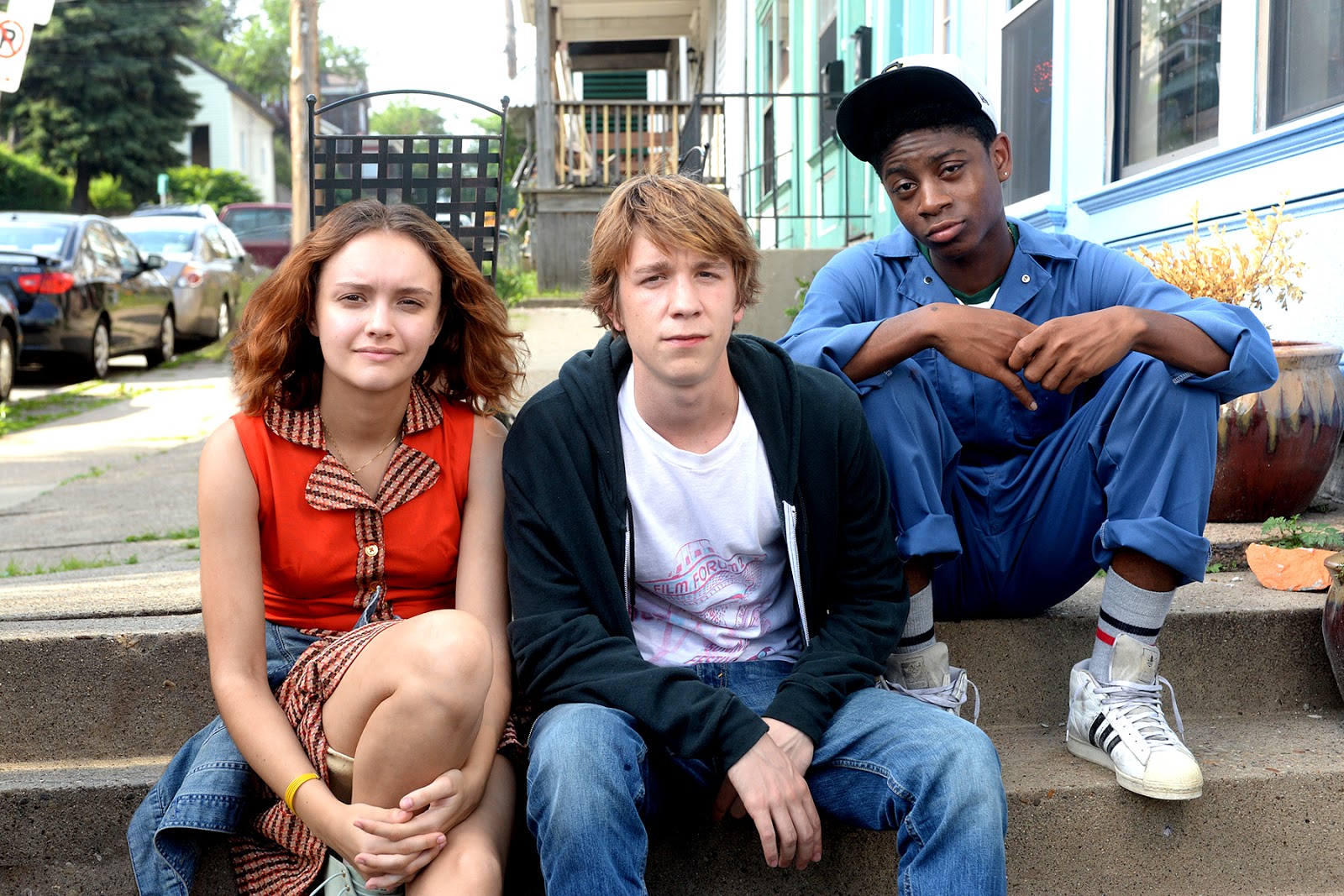
Thomas Mann plays Greg, a high school loner who's decided to avoid conflict as best he can by staying under the radar and keeping human connection to a minimum. His one friend (who he refers to as his "co-worker") is Earl (RJ Cyler), a truth-spouting fellow outsider who shares Greg's love for classic movies. Together, the two make an endless series of knowingly quirky film parodies - but their movies are a secret from everyone but Greg's eccentric college-professor dad (a winning Nick Offermann). One day, Greg's Mom (an equally winning Connie Britton) urges her son to hang out with Rachel (Olivia Cooke), who's recently been diagnosed with leukemia. She sees it as an act of charity, and Greg sees it as an annoying obligation. And Rachel, upon first meeting Greg, is in no great hurry to spend forced hang-out time with a random guy who's never previously been all that friendly to her (her mom, played hilariously by Molly Shannon, is much more excited about the whole thing). But Greg and Rachel hang out, and slowly but surely, they form a close bond - with Earl in the mix as well. The three become an unlikely trio of friends, but the specter of Rachel's increasingly debilitating illness looms over them.

The central trio of Mann, Cyler, and Cooke are all extremely likable and turn in some really excellent performances. Cooke in particular has been impressive of late in everything she's been in, from her role on Bates Motel to the underrated The Signal to this film - she always brings a lot of unexpected depth to the characters she plays. And she really wins you over as Rachel. Cyler too is really great as Earl. He comes from a rougher neighborhood that Greg, and doesn't wallow in the same sort of self-pity as his emo friend. Cyler is really funny, and Earl's straight-talk style provides a lot of the movie's best moments. Now, Mann is quite good as Greg. But his character is the hardest to really like of the main three. Greg feels too much like an amalgam of every high school movie geeky-protagonist cliche. He's got his high-school mapped out into easily-definable clicks? Check. He's got a pop-culture reference for every occasion? Check. He's got a cute girl that seems super into him but for some reason he ignores her because clearly he's not even in her league even though he's basically just a normal if slightly-awkward dude? Check and check. Greg can be annoying at times, but to Mann's credit he does layer in some genuine acting and emotion beneath the obligatory layers of quirk.

And as I alluded to, the movie's supporting players are fantastic. Offerman, Britton, Shannon - all excellent as Greg and Rachel's parents. Jon Bernthal also does very solid work as a sympathetic teacher.

Director Alfonso Gomez-Rejon also does a lot to elevate this one above the teen-drama competition. Greg loves classic movies, and although it feels slightly cliche-ish, Gomez-Rejon makes it work by infusing this film with a palpable sense of fun and genuine affection for the films that its protagonist is so obsessed with. Seeing Greg and Earl's many film parodies could have been tedious, but they are presented with such a sense of whimsy and creativity that you can't help but dig 'em. Throughout the movie, Gomez-Rejon pays tribute to and slyly plays with classic film conventions as well - in the way that he shoots certain scenes and in the way he occasionally subverts expectations with the story. Credit also to writer Jesse Andrews (who adapted the screenplay from his own novel) for crafting a story that makes an effort to be a bit different.

Still, I do think that the movie is occasionally too movie-like and self-referential for its own good. The film tries at once to be authentic-seeming and slice-of-life, but also cinematic in a clearly-this-is-a-movie way. A lot of scenes - including the film's affecting but far-fetched climax - feel overly-contrived in a way that can undermine the film's stab at capturing authentic teenage life. By that same token, I think that Cooke helps elevate the role of Rachel, but there is still an element of manic-pixie-dreamgirl-ness to her that at times makes her feel like the classic only-in-the-movies dorky guy's dreamgirl. 

Overall though, I liked ME AND EARL AND THE DYING GIRL, and its charms won me over despite some of my reservations about the film's slightly-trying-too-hard quirk-factor. The movie is indeed a charmer, and it successfully choked me up a couple of times thanks to a fearlessness at going all-in with its premise and not shying away from sadness and pain. Through it all though, the film balances out the melancholy with wit and humor and likability. Yeah, it's heightened and emo and a little *much* ... but what teenager isn't?

My Grade: B+

Sunday, June 21, 2015

INSIDE OUT Is a New Pixar Classic


INSIDE OUT Review:

- To distill complex ideas and concepts into easily-palatable art that can be enjoyed and appreciated by all ages is no easy feat. And yet, with INSIDE OUT, the geniuses at Pixar do just that. They create a film so thematically rich and resonant that I have to say - it left me somewhat floored. This isn't the first film or TV show to look inside someone's head and anthropomorphize emotions. We've seen it in works from the old sitcom Herman's Head to Epcot Center's defunct ride Cranium Command. But never has a look inside a person's head been realized - visually or thematically - with this much thoughtfulness and artistry. INSIDE OUT is not just the best Pixar movie in years, it's right up there in the top two or three films that the storied studio has ever produced.

INSIDE OUT takes us inside the mind of young Riley, a girl who's been uprooted from her life in the Midwest to hilly, hippy San Francisco. The trauma of the move, combined with all of the normal preteen anxieties and awkwardness, means that a lot is going on inside Riley's head. And the film shows us how all of that plays out by going all in - showing us the inner workings of Riley's mind via personifications of Joy, Sadness, Fear, Anger, and Disgust.

The movie brilliantly conveys how these core emotions develop from infancy and through childhood, to the point where, in the preteen years, they once again begin to evolve and change. Watching the film from an adult perspective, there's an undeniable sense of nostalgia-tinged sense of loss in seeing Riley slowly stray from childhood innocence into pre-adult hyper-awareness of reality. Wonderment and imagination is supplanted by stress, social anxiety, familial frustration, and all-too-acute self-awareness. The effect is like watching a band make intricately composed music out of a few basic notes. It helps that the emotion-characters are so amazingly realized. Their designs are perfect - totally embodying - simply yet effectively - what each represents. And the voice-acting is similarly fantastic. Amy Poehler is award-worthy as Joy - spunky, caring, determined. But what's really interesting here is the interplay between Joy and Sadness. Sadness, voiced in a memorable and at times heartbreaking performance by The Office's Phylis Smith, is perhaps the film's most stand-out character. In part because Smith makes her both painfully reflective of the way in which we actually feel sadness, but also because the movie emphasizes just how important Sadness is in order for a person to experience Joy. The two characters are companions in the movie, just as the two emotions are intertwined in Riley's brain. It's a powerful idea that's at once both simple and incredibly layered - that in order to be well-rounded, empathetic people - we need to be able to experience and understand sadness.

There's a deep sense of nostalgia for childhood innocence in the film - it will likely have you thinking back to formative moments of your childhood in a way you likely haven't in a long while. But INSIDE OUT is also an incredibly fun and funny film. Louis Black was a standout to me as Anger. As with the other emotions, Anger seems to perfectly embody the way in which our own rage-meters actually get triggered. But man, Black is also hilarious in the role, serving as a red-hot rage-machine counterpoint to the sullen Sadness and peppy joy. Meanwhile, Mindy Kaling's snarky Disgust and Bill Hader's neurotic Fear round out the movie's comedic trio. When Joy and Sadness leave Riley's control center on a mission to prevent catastrophe, the scenes of Disgust, Fear, and Anger left to haplessly hold down the fort are consistently off-the-charts funny and entertaining.

What's also interesting is that, even though we get such a complex look at what's happening inside Riley's head, that fact never really undermines how great of a character Riley herself actually is. Riley could easily have felt like a walking puppet whose strings are being pulled. But instead, she feels fully-drawn and someone that we really, really root for. We just want her to turn out okay, and we cringe whenever Anger or Sadness or Disgust takes over and seems to derail her from being happy and her best self. Similarly, we can't help but feel a sense of loss as we see her growing up at the expense of childhood flights-of-fancy, like her almost-entirely-forgotten imaginary friend Bing-Bong (voiced amusingly by the always-great Richard Kind). But again, what's great is that while Riley's emotions are universal, she herself is still a very specific character. That means that the movie can have some real fun when it shows us fleeting flashes of other people's heads. The results are often really funny, but it's also sort of poignant to see how we can all be so different and yet so uncannily alike. This is a film that espouses empathy, and it does so in a deceptively smart and nuanced way.

INSIDE OUT would be an impressive film just by virtue of how spot-on it is in its representation of our memories, thoughts, and emotions. From the way our unconscious mind creates dreams and nightmares, to the way that an earworm ad jingle can get lodged in our brains, INSIDE OUT feels dead-on with its incredibly well-thought-out depiction of the human mind. Visually, Riley's mindscape is gorgeously rendered, with every aspect seemingly thought through to the last detail. At the same time, we never care about Joy and the rest of the emotions at the expense of Riley.

I could rave about INSIDE OUT for many more paragraphs, but I'll just compliment by saying that the film itself works in the same way as Riley's emotions do. This is a film that goes to some surprisingly dark and somber places, but in doing so it rewards us with true joy and heartfelt emotional connection. It's Exhibit A of what separates Pixar's best from the rest of the animation pack - they don't take shortcuts to get us emotionally involved in their stories - they don't hold back or pull punches, and that makes the payoff that much more meaningful. INSIDE OUT is a movie that will tug on the heartstrings of even jaded adults. But more importantly, there is an important and brilliantly-realized message here about understanding ourselves, and in doing so understanding and empathizing with others.

My Grade: A

Sunday, June 7, 2015

SPY Is the Best Melissa McCarthy Vehicle To Date


SPY Review:

- I've been a fan of Melissa McCarthy for a long time now. I loved her on Gilmore Girls way back when (yes, I'm a "Gilmore Guy"), and thought she was hilarious in early breakout movie roles in Bridemaids, This Is 40, etc. But I've also been weary of this multifaceted comedic actress being typecast repeatedly as the blue-collar slob who falls over a lot and gets the easy laugh. Not that there's anything wrong with that, per se - but too many movies have forced McCarthy into one-note, one-joke roles that quickly wear thin. But SPY is perhaps McCarthy's best starring movie role to date - she gets to play a multifaceted character who is smart and capable, but still funny and flawed. She also gets to play a part that not-so-subtly takes jabs at the actress' prior film roles, and the Hollywood system that to an extent forced her into them. It speaks to the fact that SPY is a much smarter movie than the marketing perhaps let on. It's also much funnier. It's a testament to McCarthy, to the strong supporting cast, and to director Paul Fieg - a guy who knows how to portray likable underdogs as strong, fully-fleshed-out, subversively funny characters. So don't write off SPY until you've seen it - it's deceptively good.

In SPY, McCarthy plays Susan Cooper - a CIA agent stuck with an unglamorous desk job, providing support and intel to Jude Law's James Bond-like Bradley Fine. But when things go wrong on one of Fine's missions, McCarthy is forced to go into the field to identify the mysterious badguys who took him out. And suddenly, the woman who everyone underestimated and condescended to gets a chance to show that she can handle herself like a boss.

It could have been cheesy and groan-worthy, but SPY handles its premise cleverly and with a keen sense of self-awareness. McCarthy's Cooper is still goofy and self-effacing, but we also get to see a side of her that is at times downright badass and not to be trifled with. A lot of the fun comes from the great dynamic between Susan and Jason Statham's would-be super-agent Rick Ford. Statham is basically playing a parody of the typical Jason Statham character ... and he's absolutely hilarious. We know that Statham has comic chops - witness the Crank movies as a prime example. But he himself has never really been the butt of the joke like he is here, and it's an unexpected turning of the tables. Law is also a standout here, as is Miranda Hart as Susan's more-awkward desk-jockey CIA friend. Hart and McCarthy have a really fun best-friend chemistry going.

The film works on a lot of levels. It's got some really fun action scenes, and functions well in general as a parody and homage to the spy genre. But it's also got an upbeat, positive message about defying stereotypes and breaking out of the cycle of being "typecast" in life. Some of the jokes don't land, and there are elements that feel a bit clunky (Rose Byrne gives her all as the villain, but her character is all over the map). But Feig (who also wrote the film) again proves himself as someone who can take ideas that seem generic on the surface, and really give them an added layer of depth both from a comedic and thematic perspective. SPY is one of the big, pleasant surprises of Summer 2015.

My Grade: B+

Monday, May 25, 2015

TOMORROWLAND Espouses Optimism, Causes Cynicism


 TOMORROWLAND Review:

- There's a strong underlying message to TOMORROWLAND, and there's a lot, on the surface, that makes this a likable, easy-to-root-for film. This is a movie 100% designed to appeal to our sense of nostalgia for the future that never was, and for me - and I suspect many of you - that is a pretty easy button to push. It's funny - I think my generation may have a unique perspective on the all-too-quick evaporation of the utopian-future dream. Growing up on the east coast, trips to Disneyworld were a once-every-four-years, super-special occasion for me and my family. And with that sort of gap between visits, it was easy to spot - even as a kid - the way in which Disney's original vision of the future was changing in relation to how we saw it in our popular consciousness. Sure, the original vision of Disney and its utopian Tomorrowland was born of a post-war society - with visions of jetpacks and robot maids ingrained in the hopes and dreams of young Baby Boomers. But growing up in the 80's - raised on re-runs of The Jetsons and countless other new and recycled utopian visions - that World's Fair dream still felt very much alive. As a kid, even a passing familiarity with the darker, apocalyptic futures becoming popular in more adult sci-fi fare didn't faze me. That seemed like pure fantasy, with the utopian, robot-maid vision of the future seeming to be where we were actually headed. That was reaffirmed when visiting Disneyworld: Tomorrowland was still named as such in a very literal sense. That is, until it wasn't. A few years later, and Tomorrowland was re-branded as "the future that never was." Suddenly, as if almost overnight, the once-wondrous visions in Tomorrowland and Epcot Center seemed outdated and quaint. Flying cars, friendly robots, and colonies on the moon? In the emerging world of the internet, such flights of fancy seemed, sadly, obsolete. 

But man, the pull of that once-promised world is strong. And TOMORROWLAND, the movie, zeros in on that same feeling that many of us dreamers have had for a long time: where did it all go wrong? How did we go from a world where technology promised us an incredible, utopian tomorrow to a world where, at best, each new tech innovation seems only to amplify the worst aspects of our society? TOMORROWLAND argues that the original vision of Disneyland, Disneyworld, Epcot - and the whole post-war utopian dream - is not quaint or silly, but still valid, and possibly more vital than ever. And in a world that seems to yearn for hope and change, the timing seems apropos. It's a powerful, timely message, and on the surface a movie that beams that sort of positivity out into the world is one that I want to get behind. 

The problem is that TOMORROWLAND is 100% surface-level. It hammers home what's on its mind in excruciating detail, in the most unsubtle, on-the-nose way possible. There's almost zero subtext here - the film is heavy-handed and, I'm sorry to say, pretentious. It too often feels like watching a college freshman's essay on everything I said in my opening paragraph play out in movie-form, unedited and unfiltered. And I hate to say it, but this sort of thing has, by now, become a recognizable trademark of screenwriter Damon Lindelof. We saw it with the final season of Lost, we saw it with his follow-up series The Leftovers, we saw it with his scripts for Prometheus and Star Trek: Into Darkness. By now, a sci-fi script from Lindelof follows a clear structural pattern: 

a.) The premise of the film is introduced in a vague, mysterious (some might use the term "mystery box") manner. Even though there's nothing inherent to the plot that demands it be presented as a mystery. Everyman characters are introduced who are thrust into a situation they don't understand.

b.) The main characters ask a bunch of questions trying to solve the mystery, probably because they've met an all-knowing character (of mysterious origins) who soundly refuses to answer any of their questions. Repeat ad nauseum.

c.) The mystery is built up over such a prolonged period that whatever the "answer" is, it can't possibly live up to our expectations. Suffice it to say, the "answers" are revealed far too late in the story, and ultimately prove vague and unsatisfying. 

d.) This leads to both the creators and some ardent fans claiming that the story was never *about* the mystery, even though the vast majority of the movie/TV show was spent setting up said mystery. Since so much time was spent on mysteries, unanswerable questions, sketchily-defined mythology, etc. - this means that the endgame will undoubtedly contain either huge info-dumps or very hasty character reveals. 

TOMORROWLAND is incredibly Lindelof-y in just about every way possible. It's frustrating, because I think Lindelof does have a knack for stories that do a fantastic job of setting up their own premise and that create an intriguing sandbox. But seeing this movie only a week after the bar-setting Mad Max: Fury Road, it was hard to stomach TOMORROWLAND's contrivances. Fury Road so elegantly set up a rich fantasy world, told a powerful story, and layered its action and characters with thematic depth. But TOMORROWLAND is both a structural mess and thematically confused. Let me try to explain.

Okay, so here's the first thing about TOMORROWLAND. It's ostensibly about a bright, utopian vision of the future. Its premise involves an enlightened society created by scientists, visionaries, and dreamers - a real-life Tomorrowland - hidden away in another dimension, full of wondrous inventions and general awesomeness. But TOMORROWLAND, the movie, is actually pretty dark. We barely glimpse the movie's fictional Tomorrowland, at all, throughout the movie's entire run-time. Our main character, Casey (a really great Britt Robertson), is a teen girl who lives in a bleak, perpetually grey world - our world, America, 2015. She spends her time finding ways to foil the shutdown of various NASA locations - because in our dark and gloomy world, there's no place for a space program. Most of the movie takes place right here, in our world. So imagine The Wizard of Oz, except you actually see Oz for about ten minutes, and the rest takes place in black-and-white Kansas. We don't meet any of the dreamers who founded Tomorrowland or who eventually populated Tomorrowland. The only real remnant of Tomorrowland that we do spend time with is George Clooney's Frank Walker, who for 95% of the film is an insufferable grump. I meant it when I said this movie has structural problems. It spends so long on the "mystery" of the movie that it pretty much never gives us the good stuff - namely, the thing that's in the movie's title. It's why, despite the movie's final message of hope and optimism, I found it to be, in actuality, a pretty cynical-seeming film. By spending so much time showing us how much *our* world sucks, TOMORROWLAND actually undercuts its own intended message, and is dominated by a bleak tone that's contrary to what the movie actually seems to *want* to convey.

A lot of the issues here come back to the structure of the film having major problems. The movie starts and ends with an expository wraparound that feels completely extraneous - not a great sign. Then, the movie opens - for reals this time - with a very over-long prologue showing a young Frank first discovering the secret of Tomorrowland, after a detour at the 1964 World's Fair. Then we meet Casey, and a mysterious girl named Athena who's recruited Casey for a special mission. Early on, we get glimpses of Tomorrowland, when Casey finds a pin that, when touched, shows visions of the otherdimensional utopia in its space-age prime. But mostly, we get a road trip movie - following the mismatched trio of Casey, middle-aged Frank, and Athena - trying to get back to Tomorrowland while on the run from mysterious pursuers. Why are they being pursued? Why do they have to go back to Tomorrowland? Why did Frank leave in the first place after discovering it as a boy? What's up with Athena? All of these questions are dealt with (or not dealt with, to be precise), in an endless string of non-conversations that see Casey asking a bunch of questions, Frank doing the grumpy, I-just-want-to-be-left-alone, but oh-wait-I'm-actually-a-good-dude schtick, and Athena playing the Obi Wan role. This all leads to an eye-rolling third-act scene in which Hugh Laurie, as the ominously-named uber-villain Nix, monologues the entire plot, premise, and themes of the film after about two hours of "mystery box" storytelling. It's the info-dump to end all info-dumps. But what's worse, it's not just an info-dump, but as I said (to borrow a phrase I've seen in some other reviews), it's a theme-bomb. Hugh Laurie spells out, in no uncertain terms, exactly what the movie is about. 

It's a shame that Tomorrowland itself isn't more prevalent in the film. When we do see it in full - in the prologue and later via Casey's pin - it's pretty spectacular. And this brings me to director Brad Bird. Like many, I'm a big fan of Bird and think he's a pretty incredible (no pun intended) visual stylist. So it's no surprise that TOMORROWLAND is at its strongest when Bird has the opportunity to really let loose and go big. In particular, Casey's first full-on foray into Tomorrowland sticks out to me as a highlight, and as a demonstration of the promise of the film's premise. Brad's vision of Tomorrowland is a sugar-high realization of that utopian world that Disney promised us way back when: gleaming spires, jet-pack stations, hovering monorails, cascading fountains, space-age design, colorfully-clad citizens. It's a place buzzing with visual marvel and eye-popping innovation. Brad gives us a hyper-speed tour of Tomorrowland in a dazzling sequence, and it's worth the price of admission just to see this on the big-screen.

The film's other most dazzling effect is actually the fantastic performance of young Raffey Cassidy as Athena. I don't want to spoil too much about her character, but Cassidy is 100% believable as a girl who is older and wiser than she looks, and who is uber-competent and capable yet also supremely charming. Cassidy quite frankly steals the show as Athena. As mentioned, Britt Robertson is also a standout. Bird and Lindelof (and co-writer Jeff Jensen, of Entertainment Weekly) clearly wanted to make her a young-adult heroine in the Spielbergian mold. Single-parent household, precocious younger sibling (ironically played by Pierce Gagnon - who played a robotic boy on the TV show Extant), NASA hat that she has at all times, handy with technology? Check, check, check, and check. But hey, I'm a sucker for Spielberg kid-protagonists, and Robertson is great in the role - carrying a lot of the weight of the movie on her shoulders. 

But here's the other thing - and again, it's a question of weird structural issues: Robertson's Casey very quickly becomes a largely passive hero. And by the film's end, she's completely sidelined. It's indicative of how broken the movie's entire third act really is. But it's also a shame, because Casey is really who we're set up to root for the entire film. Not only that, but over and over, we're told (flat-out told) that she is special. She is "the one" who will save Tomorrowland from Nix. But other than just being generally plucky and idealistic, Casey is never given the chance to really do much of anything to live up to that claim. Meanwhile, Clooney's Frank hogs a lot of her spotlight, but his character's arc feels entirely forced. Because Frank's backstory is kept a mystery for so much of the film, his late-game about-face from grumpy cynic to world-saving hero is pretty unsatisfying, and feels unearned. Chalk up some of it to Clooney being miscast. The guy gives great intensity, but whimsey isn't really his strong suit. I kept thinking what a Tom Hanks or the late Robin Williams could have done with this role. Clooney doesn't seem well-suited to portray a guy who rediscovers his inner-dreamer. But the script also doesn't do him any favors. 

Clooney's oddly-intense performance also speaks to the general tonal weirdness of the movie. Like I said, much of the film feels oddly bleak for a story that espouses the virtues of utopianism. It really could have used some fun characters to make this feel like more of the swashbuckling, Spielbergian sci-fi adventure movie that it at times wants to be. It almost seems like Brad Bird is grasping at straws to mine whatever Spielberg-esque moments of real fun and adventure that he can from the dour script. That gives us moments like Casey's action-filled encounter with two over-the-top badguys (played by Keegan-Michael Key and Kathryn Hahn) who run a sci-fi nostalgia shop, Blast From the Past. Or her and Frank's daring escape from Frank's tricked-out house, as they face off with creepily-fun robotic adversaries. Both of these set-piece action sequences are fun as hell, and Brad Bird totally nails 'em. But the fun and humor of those scenes feel like they belong in some other, better movie. And both happen early on in the film. Ultimately, that sense of fun and adventure becomes drowned out by the script's dourness and pop-psychology preachiness. At its highest points, TOMORROWLAND is a rip-roaring, nostalgia-tinged adventure that feels like a mash-up of the best live-action Disney and Amblin films of the 80's. Which makes it all the more frustrating that so much of the film is a heavy-handed slog.

I've seen some people who enjoyed TOMORROWLAND lash out at those who didn't - the haters, it would seem, are in fact the same sorts of doom n' gloom naysayers that the movie lambasts. But that generalization is unfair. I love the *idea* of TOMORROWLAND, and I wholeheartedly dig the message espoused at the film's end - a sort of call to action for we as a a society to dream big and work together for a better future. I can get behind that. And certainly, I've long been inspired by the Disney version of the future, even once it resigned itself to merely being the future that never was. I mean, there's a vintage Tomorrowland travel poster hanging above my desk as I write this. But a nice message doesn't automatically make for a good movie. And this is a movie that repeatedly undercuts its inherent possibilities, by dwelling too much on all the things that it *didn't* actually need in the text. All the mystery-box stuff. All the heavy-handed thematic reinforcement. They ultimately seem to just get in the way of telling a good story that fully delivers on the movie's premise. The result is a film that actually feels cynically-made, in contrast to its purported message. 

So for now, at least, the best way to feel the magic inherent in the idea of Tomorrowland is still, I think, to go to the theme parks. There, the nostalgia-tinged, retro-cool vision of the future that Walt Disney and others envisioned can still be experienced firsthand, without all the other baggage that the movie brings to the table. And if it upsets you that the film's vision of a future run by idealists and dreamers is somehow being marred by critical reviews, I say take comfort in the fact that us dreamers and idealists will still be here dreamin'. One movie's quality isn't going to change that.

My Grade: C+

Monday, May 18, 2015

MAD MAX: FURY ROAD Is an Unforgettable Ride


 MAD MAX: FURY ROAD Review:

- What is it about the classic genre films of the 80's that made them so iconic - still able to captivate our collective imagination today? I think the answer lies with the visionary directors who brought us those films. Thirty years ago, directors like Spielberg, Lucas, Donner, Carpenter, Verhoeven, Cameron, Scott, Milius, and Miller gave us memorable, iconoclastic films that felt like triumphs of the imagination. Today, most big-budget blockbusters feel assembled by committee. They're designed to be, above all, four-quadrant crowd-pleasers. Rarely are today's biggest movies allowed to get extreme, or weird, or to be disturbing and challenging. But MAD MAX: FURY ROAD is a welcome anomaly. Here we have the legendary George Miller returning to his iconic Road Warrior universe - not just for a victory lap or a nostalgia-driven cash-in, but for a movie that feels as vital, as urgent, and as singular as anything the director has yet produced in his storied career. The movie is in many ways a minor miracle - a blast of adrenaline-fueled badassery that absolutely refuses to conform to modern blockbuster convention. Ironically, that rebellious, rock n' roll mentality makes FURY ROAD feel fresher and more avant-garde than any mainstream action movie in years. It's a must-see new classic. A movie that at once feels like a throwback to the glory days of badass 80's genre films and like something we've never quite seen before.

What's so incredible about FURY ROAD is how Miller effortlessly tells a story, gives us memorable characters, and gives us a fully-fleshed-out post-apocalyptic universe despite the film essentially being one giant, action-packed chase scene. So many genre films tend to be over-expository. But FURY ROAD masterfully gives us exactly what we need via some brilliantly economical storytelling. This is an exaggerated, larger-than-life world. And so must its characters be mythical and iconic. And such is Max. Tom Hardy brings the character to stoic life. He is this film's Man With No Name. At the start of the movie, he's literally been stripped of his humanity; captured by the feral minions of the tyrannical Immortan Joe - his "warboys" - and made into a human plasma-source, a "blood-bank." As the film progresses and Max eventually frees himself of his shackles, he slowly begins to regain a sense of identity. Hardy makes for a great Max. His gruff stoicism and survival-mode brutality slowly give way to some semblance of empathy and sense of purpose. Hardy continues to be one of the best actors around, and Max is a natural fit for him. He truly gives him the sort of mythical icon status befitting of Miller's vision.

But really, this isn't Max's movie. For in truth, the film belongs to Charlize Theron's grit-filled, can't-stop/won't-stop, badass-for-the-ages Imperator Furiosa. Furiosa, a lieutenant of Joe, has been secretly smuggling slaves out of his fortress-like city, The Citadel. Now, she's on a desperate escape mission, making off with one of Joe's big-rigs, transporting a cargo of Joe's "wives" - female sex slaves meant to carry Joe's unholy offspring. Headed through the barren Wasteland in hopes of reaching a mythical Green Place, Furiosa is pursued by a battalion of Joe's ravenous warboys, as well as Joe himself. That's when she crosses paths with Max, who's been chained to one of Joe's souped-up battle-vehicles and finds himself unwillingly along on the hunt for Furiosa. Theron kills it. Seemingly channeling the spirit of Sigourney Weaver in the Alien films, Theron as Furiosa is bald, one-armed (she's got a metal prosthetic), steely-eyed, and certifiably awesome-sauce. She gives the character a quietly desperate intensity and inner rage that makes her downright scary at times. And in the few quiet moments allowed to her, we also see the long-simmering pain. We know she's witnessed atrocities and likely participated in some as well. Now, she seeks some measure of redemption. No question though - Furiosa is a cinematic icon for the ages.

What makes Max and Furiosa's adventure so harrowing is the fact that Miller crafts an army of unrelenting antagonists that is the stuff of pure sci-fi nightmares. Immortan Joe - played by Hugh Keays-Byrne - is instantly the stuff of villainous legend. A hulking figure clad in imposing body-armor and a skull-shaped, tusk-lined mantle, Joe is a grotesque Big Bad who will stop at nothing to retrieve his stolen "wives" and destroy those who dared oppose his will. His army is also suitably over-the-top: a motley crew of murderers and would-be martyrs. His warboys are convinced that dying for Joe will mean an eternity in Valhalla. And so they throw themselves into danger with animalistic abandon. Most intriguing of Joe's warriors is
Nicholas Hoult's Nux - an overeager foot soldier who begins to have a crisis of conscience, when he realizes that his great leader may not be quite as worthy of fighting and dying for as he'd believed.

All of FURY ROAD's relentless action is filmed with absolutely gorgeous flair by Miller. Though things unfold with fast and furious intensity, Miller never falls prey to the sort of disruptive quick-cutting and shaky visuals that make other blockbusters feel visually incomprehensible. What strikes me about the film is just how painterly the whole thing feels. Amidst the chaotic action and nonstop adrenaline-rush, there are countless individual moments of near awe-inspiring beauty and jaw-dropping imagination. Oh, Miller's vision is often cartoonishly over-the-top, to be sure. But what glorious over-the-topness it is. One of my favorite recurring visuals was that of the awesomely absurd musical section of Joe's battalion - a multi-story vehicle carrying war-drummers followed by a mobile stage on which a suspended, seemingly rabid warboy plays a continuous electric guitar-solo - a heavy metal symphony of destruction if ever there was one. It's an apt visual, as Miller's vehicular action plays like a post-apocalyptic symphony - the action orchestrated via choreography that's downright musical in the way it elegantly unfolds. In the film's climactic battle - as warboys pole-vault between vehicles while Furiosa and Max make a desperate last-stand, the sheer chaotic beauty of the action is just overwhelmingly awesome. There are smaller, quieter moments sprinkled throughout the movie in which Miller will pause on a particularly striking visual. But even when the action is at its most intense, Miller still takes care to give us consistently beautiful brutality.

Amidst all of the nonstop action, Miller infuses FURY ROAD with a simple but effective tale of finding hope and redemption - of the triumph of the human spirit when things look bleakest. There is a feminist undercurrent as well, as Miller's story is largely about women fighting against a patriarchy that treats them as a resource to be exploited as opposed to equals to be respected. In many ways, the film reminded me of "journey" movies like Gravity - a deceptively simple but thematically complex parable about the human spirit's ability to overcome even the most seemingly hopeless of situations. I could go on, but suffice it to say that FURY ROAD has a lot going on between the lines, and a lot of substance to unpack and discuss. Miller clearly has a lot on his mind with this movie. In many ways, it feels like he finally struck at the heart of what he's wanted to say since the first Mad Max film. As such, while this film feels like something new, like something not tied or bound to Mad Max or The Road Warrior or Beyond Thunderdome, it also feels like a fitting conclusion to this universe and a fitting goodbye for Max. Miller takes us into the abyss, but here, finally, we can see some light at the end of the tunnel. Max was never a savior, only a victim of (and sometime hero because of) circumstance. But here, Furiosa steps in as the woman the world needs. Max just gives her the final nudge to do what needs to be done.

Oftentimes even the best modern blockbusters succeed by hitting various pleasure centers in the brain, checking off boxes and generally presenting us with a fun roller-coaster ride. MAD MAX: FURY ROAD is one hell of a roller-coaster ride. But it's also the kind of blockbuster you don't see much of anymore - the kind that seeps deep into the recesses of your brain and fires up the synapses and sparks the imagination and really *sticks*. It's the kind of movie that isn't trying to please everyone, that dares to be weird and gross and dark and sort of insane. And man, we could use more like it. We could use more directors like George Miller. We could use more movies like FURY ROAD. 

My Grade: A

Monday, May 4, 2015

AVENGERS: AGE OF ULTRON is Entertaining But Largely Emotionless Would-Be Epic


AVENGERS: AGE OF ULTRON Review:

Minor Spoilers Ahead ...

- The first Avengers film was a fairly awesome culmination of "Phase 1" of the Marvel Cinematic Universe. It delivered a satisfying team-up of Marvel's finest, and it felt like a well-earned payoff to much of what had come before. In contrast, AVENGERS: AGE OF ULTRON feels like an aimless, overstuffed midpoint in this grand Marvel experiment. It's plenty fun - there's entertaining action, lots of Joss Whedon's trademark quippy dialogue and humor, and a breakout, damn-cool new character in the android hero The Vision. But the whole affair is oddly emotionless. The film seems so intent on cramming a universe worth of characters and subplots into its two-and-a-half-hour running time that most of its major arcs feel rushed. What makes that particularly disappointing is that AGE OF ULTRON has the ingredients to be a movie with real thematic heft. This could have been the ultimate Marvel version of Frankenstein, with Tony Stark as the prideful mad-scientist at its center. But what we get is the movie equivalent of what comics fans are all too familiar with - the mega-crossover that promises world-changing epicness but instead boils down to a lot of sizzle without much steak. Of course, if this were comics, we'd have about three dozen tie-ins and crossover books to provide substance that helps to flesh out the main arc. But what we get is one movie that has to do it all - tell a great standalone story, pay off the last half-dozen Marvel movies, set up the next "phase" of this universe ... and the list goes on.

There's at times a sense then that this movie was pushed out of the Marvel/Disney factory with little motivating its existence other than a dutiful sense of obligation. Given that, it's perhaps a minor miracle that the film is as good as it is. But for every too-clever Whedonism that hits, and every nerd-out moment that causes audiences to applaud, there's a lot of zooming from Point A to Point B that to some extent drowns out the movie's best bits. As we know, Marvel has a plan. But it's also important that its films don't feel like mere parts of a plan.

Despite what I just said, there's not that much back-story you really need to know to dive into AGE OF ULTRON. There's some follow-up to Winter Soldier, with The Avengers now working in a post-S.H.I.E.L.D. world and having their own distinct HQ. And the film opens in media res with the team infiltrating one of the remaining Hydra facilities, where some evil Nazi types make a last stand by unleashing "the twins" - Scarlet Witch and Quicksilver - on their foes. From there though, the film quickly transitions to its main focus: Ultron. A super-advanced AI created by Tony Stark, the program created to be a global protector decides that the only way to create true peace is to ... wait for it ... destroy humanity. So the James Spader-voiced program creates a humanoid body for itself, takes control of an army of Iron Man 'bots, recruits mind-controlling Scarlet Witch and speedster Quicksilver as his henchman, and decides to go all-in on the whole supervillain thing.

From the get-go, things seem to barrel forward without much time given to proper build-up. We've seen a lot of films about artificial intelligence of late, including a great one in Ex Machina. There's a lot of interesting stuff to be mined from an AI created to bring peace developing an appetite for destruction. But for all of the long-term plotting we've seen in these Marvel movies, Ultron's turn to the darkside is remarkably sudden. Not only that, but his evolution from non-corporeal AI to wise-cracking, one-liner-spouting, evil-scheming robo-Spader is nearly instantaneous. Spader adds an amusing smarminess to the character, but ultimately, Ultron falls mostly flat as a Big Bad.

And a huge reason for that is one that could have easily been fixed, and one that seems like a huge miss for the film: this should have been, first and foremost, Tony Stark's story. Stark stubbornly created Ultron - a villain who goes on to wreak massive havoc - and yet AGE OF ULTRON just barely scratches the surface of what this all means. For one thing, the movie should have built to a climactic showdown between creator and monster. But amidst all the chaos of the film, Stark is too often sidelined. And what of the emotional toll that creating Ultron might have / should have on Stark? There's barely a hint of real weight in the film. Ultron should have been Stark's greatest failure - an epic mistake of hubris that forces him to re-evaluate everything. But that character arc is either ignored or being saved for another movie. AGE OF ULTRON does have a couple of big scenes of tension among the Avengers that seem to set the stage for continued drama. But by film's end, all is pretty much forgiven. It's not just a matter of waiting for Civil War or what have you. AGE OF ULTRON suffers for not following a clear character arc for Tony and with regards to his relationship with the rest of the team.

The film's clutter also severely hampers the introductions of Scarlet Witch and Quicksilver. Again, it's odd - because their back-story is yet another thread that ties back to damage caused by Stark that has come back to haunt him. But even with their anti-Stark agenda, the twins' motivation for allying with the obviously evil-with-a-capitol-E Ultron seems pretty shaky. It's why their eventual turn to the side of the heroes feels weightless and rushed.

One more aspect of the film that seems awkwardly shoehorned in: a romantic subplot between Bruce Banner and The Black Widow. Without any real hints of a budding romance in previous films, the mild sparks between the two feel a bit contrived. But what's worse is that some fun flirtatious moments abruptly become full-on rainbows-and-unicorns soul-mate stuff. Before the two have even gotten physical, there's awkward talk about kids and families and how their romance can never be. One step at a time, you crazy kids.

There's a lot in the film that feels like unneeded filler, especially when the meat of the story - the Stark vs. Ultron stuff - seems to struggle to get the screentime it needs. There's an extended detour to the safe house of Hawkeye that feels extraneous (though it's always nice to see Linda Cardinelli, who plays the never-before-seen Mrs. Clint Barton). There's a whole thing about Thor bathing in a mystical pool so as to conjure a vision of the Infinity Gems that could have probably been cut out. There's a trip to Marvel U mainstay Wakanda (no Black Panther cameo ... sorry fanboys) that feels like an extended tangent. These are the kinds of stories that in the comics would have probably had their own tie-in miniseries. But here, they're just bloat.

Writer/director Josh Whedon has always excelled at peppering his sci-fi epics with great little character moments. And AGE OF ULTRON is no exception. The movie's most fun sequence involves a fancy-dress party in honor of an Avengers victory that's capped off by a hilarious test-of-strength among earth's mightiest mortals to see who among them can lift Thor's enchanted hammer (and there's a great, surprising payoff to the scene later in the film, too). Whedon kills with his banter - and that's no surprise, but it's still remarkable how well he pulls this stuff off. AGE OF ULTRON is chock full of killer one-liners and asides. There's a freaking Eugene O'Neill reference tossed in there, and it's great. Whedon nails those little moments. But what AGE OF ULTRON needs more of are the truly epic, truly memorable, truly fist-pumping BIG moments. There's nothing here as applause-worthy, for example, as the Hulk "puny god!" line from the first Avengers.

What comes closest though is Vision. If there's one thing that's undeniably awesome in AGE OF ULTRON, it's him. I'm not sure if it was always the plan for Paul Bettany's Jarvis to evolve into The Vision, but if so - kudos - as it unfolds to perfection. The character just looks cool - like something straight out of an Alex Ross painting. And Whedon steps up to the plate whenever Vision is on-screen - majestically filming him like a creature out of sci-fi dreams. We don't get to see Vision take form until late in the film, but man, we're left wanting more.

When it comes to action, AGE OF ULTRON mostly delivers. It has some of the most epic action of any Marvel film to date. Some of it is pretty rapid-fire and videogame-y, but mostly, Whedon delivers some fairly spectacular, comic-book-brought-to-life battles. There are some great moments in which the characters deliver XBOX-worthy combo-attacks to their enemies. And the Hulk vs. Mega-Iron-Man battle does indeed live up to the trailer-induced hype, giving us a hero vs. hero smackdown that trumps any overhyped pay-per-view boxing match by a country mile. What Whedon also takes care to do is to make sure that the action always includes a truly superheroic element of getting civilians out of harm's way and saving lives. Many criticized Man of Steel for neglecting to show Superman's efforts to save the innocent in the midst of his destruction-causing battles. AGE OF ULTRON, in contrast, is incredibly concerned with the idea of heroes saving people as being their defining characteristic. In many ways, it's a theme that's defined this era of modern Marvel movies. But in AGE OF ULTRON, it's one of the ways in which the film inspires true awe and wonder despite whatever other flaws it may have. It's fun to see the Captain America ideology of selflessness permeating through the broader team - even if the Tony Starks of the world miss the forest for the trees.

AGE OF ULTRON delivers plenty of spectacle and explosiveness. But it's also a messy film - one that seems to be pulled in so many directions that its obvious thematic through-line feels trampled-on and obscured. Creator vs. creation, father vs. son, man vs. machine - these are weighty themes that should and could have produced multiple epic, chill-inducing moments. But the film seems content to breeze by a lot of the big moments in the name of cramming in everything and the kitchen sink. Think of comics. They speedily direct the reader from panel to panel, and then deliver the big, dramatic moments with jaw-dropping full-page splash pages. AGE OF ULTRON feels like a big comic composed of 180 12-panel pages. On paper, this is the blockbuster to end all blockbusters. But in practice, this one was lacking the jaw-dropping moments that truly make a big movie like this an epic and a classic. The movie checks all the boxes - it's entertaining and fun and full of Whedon-powered wit. Is it the ultimate Marvel epic that we've been waiting for, however? Nope - for that, looks like we've got to keep on waiting.

My Grade: B+