A Collection of Thoughts, Rants, and Reviews. Movies. TV. Games. Comics. Music. Pop-Culture. Follow Me On BlueSky, Threads, or Instagram.
Showing posts with label Matthew McConaughey. Show all posts
Wednesday, November 12, 2014
INTERSTELLAR Is a Mind-Blowing Cosmic Odyssey
INTERSTELLAR Review:
- Rarely has a major blockbuster movie been as torn down, nitpicked, and hyper-scrutinized as much as Interstellar. But that's par for the course for Christopher Nolan, who has become increasingly divisive over the years. I too have had my doubts about the director. The Dark Knight Rises, to me, was a real misstep, and it was the sort of misstep that only served to shine a bright spotlight on some of the director's storytelling weaknesses. The Dark Knight Rises made some question the pedestal that Nolan had been placed upon prior to its release. But one misstep does not break a career, and I challenge the doubters to remember just how damn good Nolan's still-short career has been. I still vividly remember the sheer awe I felt after first seeing Memento in the theaters. I was blown away. And time after time, I've come away from a new Nolan film with a similar sense of being filled with awe and wonder to the point of bursting. Nolan always swings for the fences, and even when the narrative scope of his movies is small, the thematic ambition is huge. But INTERSTELLAR is huge in every possible way, and it's huge in a way that few current filmmakers outside of Nolan would even attempt, let alone execute on this level. This is Epic filmmaking with a capitol "E." But does it work? The internet would have you believe that it all crashes and collapses under its own weight. But I say screw the mobs of haters jumping on the Nolan backlash bandwagon. In my view, INTERSTELLAR holds up. It's involving and compelling on multiple levels. It's flat-out mind-blowing, and it's a potent reminder of just how damn good Nolan is. INTERSTELLAR is some truly next-level movie-making that demands to be seen, and seen on the biggest screen possible.
In some ways, INTERSTELLAR reminds me a lot of last year's Gravity. It's not just the outer-space setting, it's the central theme of humanity striving to reach its ultimate potential, achieving spiritual rebirth through scientific progress and an idealistic pursuit of our species' furthermost boundaries. In the near-future world of the film, a crop-killing dust has caused food shortages and air quality issues. The earth is on a dangerous path towards being uninhabitable. What's more, in the heartland where our main characters reside, a deep cynicism has taken root that's supplanted the idealistic frontierism that once characterized America and the American Dream. Our central character is Cooper (Matthew McConaughey), a natural-born explorer who was a pilot and an astronaut before the dissolution of space program. Now, he, like many, is a farmer - tasked with cultivating whatever crops can be grown in the earth's increasingly harsh climate. His son, Tom, is assigned by his teachers to study farming. For most, this is now their assigned lot in life. Cooper's daughter, Murph, is a science-wiz, but her teachers scold her for arguing with them about what's in her textbooks. The books, it turns out, now say the moon-landing was a hoax designed to push the Soviets into a costly, nation-toppling space race. Kennedy-era idealism is officially dead. The Chuck Yeager-esque hotshot pilot is grounded. Earth is dying, and the world clings to what is left in a cynical prolonging of the inevitable. Sound familiar? Poignantly and unflinchingly, the sci-fi world of INTERSTELLAR is a dark-mirror reflection of our own.
However, Cooper eventually learns that, hidden away in an off-the-grid base, a last remnant of NASA still exists, secretly plotting out a plan that could be humanity's last, best hope for survival. Cooper is recruited by the project's leader - Professor Brand (Michael Caine) - a former mentor of Cooper's - to lead the desperate mission he and his team have devised. Years ago, a group of astronauts were sent to find a new planet that would be inhabitable for humans. The great hope lay with the discovery of a wormhole, that by folding time and space would transport any who traveled through it into a far-off galaxy. Each astronaut went to a different planet, and each sent word back whether there's had potential to be a new-earth. Now, Cooper and his crew are being sent to go through the wormhole, and rendezvous with the astronauts who have given them the thumbs-up. What happens from there depends on how things go back on earth. Plan A: figure out a way to transport humanity en masse from earth to a new planet. Brand has yet to crack the code to accomplish this, so it's not a sure thing. Plan B: use samples on Cooper's ship to repopulate on the new planet, leaving everyone already on earth to wither and die out. Suffice it to say, the idealistic Cooper strongly prefers Plan A.
Cooper is fighting for all of humanity, but most importantly for his family. On earth, he leaves behind his son Tom, his daughter Murph, and his father-in-law Donald (his wife died young). And it's those central, familial relationships that drive much of the film. Because time passes differently for Cooper during his deep-space travels (Relativity in action), his mission sees him miss out on decades of his children's lives. The emotional core of INTERSTELLAR seems like uncharted territory for Nolan. His films have often had a cold, Kubrickian clockwork-like logic at their core, rarely dwelling too much on matters of the heart. But here, amidst the film's hard sci-fi braininess and mission-driven storyline, lies a Spielbergian center of sentimentality. No wonder, given that Spielberg himself was once attached to direct the film. But even so, it creates a sort of turn-of-the-corner moment for Nolan, where his big ideas and logic puzzles are intermixed - and indeed overshadowed - by an exploration of human connection and love that lies at the heart of what INTERSTELLAR is all about. No spoilers here, but I will say that Nolan's mix of Spielbergian heart with Kubrickian remove totally works for me in this context. Stories about traveling through space and time inevitably pose questions about life, the universe, and everything. And I think it's fair to go big thematically when you're going to the farthest reaches of the galaxy. Some of my favorite sci-fi visionaries - Ray Bradbury comes to mind - were far less interested in the hard science of sci-fi than with exploring what things like space travel told us about what it means to be human. Nolan is 100% interested in the science of INTERSTELLAR, and despite some liberties taken I don't think you'll find many sci-fi or space movies that have science *more* on the brain than this one. But I also don't think there's anything wrong with injecting a bit of Bradbury-esque reflection into the narrative. It's in the genre's DNA, and it's in the movie's from moment one. This isn't some Lost-esque, would-be sci-fi narrative that suddenly and disappointingly finds all of its answers in the spiritual. Rather, Nolan is theorizing that human connection and relationships are as much of a force in the universe as time, space, and gravity. Again, especially as we go on this journey that takes us to the outer limits of human understanding, that sort of train of thought seems, to me, to be fair game.
Nolan tells this story on the biggest, widest, most epic canvas possible. When he made The Dark Knight, Nolan raised the bar in terms of combining blockbuster filmmaking with cerebral and psychologically complex themes. He again raised the bar with Inception - even as the thematics became even more complex, Nolan gave them a thunderous intensity that ensured the film never lacked for momentum. He does this again with INTERSTELLAR. The film is long and sprawling, but it absolutely flies by. It's that same thunderous power here, even more amplified than in Nolan's previous films. In IMAX, the film's cosmic visuals have you-are-there, larger-than-life pop. As per usual, Nolan grounds even the most jaw-dropping visuals in a frighteningly plausible reality, making them that much more breathtaking. When Cooper and his crew land on a watery planet whose entire surface is covered in mountainous tidal waves, you are floored by the scope of it all, but also the reality of it. The visuals of the movie, like the plot, are informed by science and physics - making them all the more effective. Nolan may not be the clean, precise visual storyteller of an Alfonso Cuaron, but he makes up for it with the sheer force and epicness of his visuals. Likewise, the script - by Nolan and his brother Jonathan - can have moments of clunkiness, but what the two lack in understated grace they make up for with numerous moments of quotable, gravitas-infused weightiness.
The film is additionally propped up by the talent of its cast. Matthew McConaughey, as we all know, has been on a tear of late. The funny thing is, what's going on around him in this film is so attention-grabbing that I think the quality of his performance may actually end up being somewhat overlooked. But make no mistake, McConaughey is fantastic as Cooper. Here's the thing - the Chuck Yeager-esque explorer/pilot part of the role is basically second-nature for McConaughey. He pretty much is that guy. But what's impressive is how well McConaughey handles everything else that the movie throws at him. For one thing, when things get really big, weird, and surreal in the film's third act, McConaughey perfectly nails the insanity of it all while not going too over the top. But even more so, the Oscar-winner nails the relationship that Cooper has with his kids - in particular with his daughter Murph. In many ways, Interstellar is a movie about fathers and daughters, and the Cooper-Murph relationship is key.
Luckily, Murph is played by two outstanding actresses. It's not surprising that Jessica Chastain is great as the adult Murph, who's grown to be the same age as her father while the effects of relativity have slowed time for Cooper. Chastain is consistently excellent in everything she's in, but here she makes the older Murph a damaged but driven woman - a brilliant scientist who, though she has a fraught and complicated relationship with her dad, may have nonetheless inherited some of his can-do idealism. What is surprising is how good young Mackenzie Foy is as the ten-year-old Murph. It's Foy's devastated reaction to her father leaving her for his mission that makes Cooper's journey that much more intense and important-feeling.
The other interesting father-daughter relationship is between Michael Caine's Professor Brand and Anne Hathaway's younger Brand. To compare and contrast the two would lead to heavy spoilers. But I will say that I was really impressed with Hathaway here. This role lets her be grittier and more mature-seeming than in past films, and Hathaway seems more serious and restrained than usual. She brings a surprising gravitas to Brand that I didn't expect. As for Caine, he memorably recites "Do Not Go Gentle Into That Good Night" by Dylan Thomas - a poem that seems like something that Professor Brand must repeat for himself as much if not more so than for others. But that, ultimately, is the mantra of the film. Rage against the dying of the light. It's the recurring theme of INTERSTELLAR, and who better than Caine to deliver it?
The cast is filled with a host of other great actors. There's a crucial role from a key actor whose identity I won't spoil ... suffice it to say he does a fantastic job of playing against type. There's Wes Bentley and David Gyasi as the other crew members on Cooper's ship. There's a badass cameo from William "Rolling Thunder" Devane. There's John Lithgow as Cooper's father-in-law. And there's a standout voice-acting role from Bill Irwin, giving life to the robotic TARS. Yes, every good space odyssey needs a super-awesome robot to make it complete, and TARS is a damn good one. The design on the 'bot is incredibly unique and fascinating to look at in motion. And Irwin's affable voice-work makes TARS one of the film's most memorable characters.
Some have griped about Hans Zimmer's score, but man, I loved it. I think there may have been some issues where the volume of the score is just too high, to the point of drowning out some key dialogue. But the score itself is fantastic. The main theme reminded me a bit of the cosmically-themed song "Contact" from Daft Punk's Random Access Memories. In any case, the future-synth soundtrack is both a bit of a departure for Zimmer and a perfect fit for the film. It's absolutely brimming with ominous intensity and into-the-void atmosphere. Completely dug it, and I think it will go down as a classic film score.
Oftentimes, it's actually the small movies that give us the best insights into life's big questions. Rarely do we get big, epic sci-fi films that have more on their mind than space battles and comic book soap opera. That's all fine and good, but I say you've also got to appreciate the rare film like INTERSTELLAR that actually, 100%, goes the distance. It takes us into space, through the wormhole, and into the great unknown, and it doesn't take any shortcuts in its journey. The film sees things through to their ultimate conclusion - and yes, that means that we get talking robots, fifth-dimensional ghosts, and ruminations on whether love is a scientifically viable universal force. If that sort of stuff makes you come down with a case of the eye-rolls, then hey, INTERSTELLAR might not be your bag. But if, like me, you live for stories that just keep digging and digging in search of the great secrets of the universe and reality itself, then this is what you've been waiting for. Nolan isn't just hurling paint on the canvass here - there's method to his madness, and those complaining about plot holes will find most if not all of the answers in the film, if you pay attention and think things through. As much as some call out Nolan for over-expository dialogue, the fact is that a lot of key details are found between the lines of the film, in quick moments or simply implied rather than said outright. Nolan's ambition also leads to some serious aesthetic risks. As the film crescendos, Nolan furiously cross-cuts between two times and locations. It's another instance where some might simply tune-out and accuse him of overreaching. But by this point in the film, all cards are on the table and there's no slowing down. The result is, to me, a gripping and operatic sequence that seared itself into my brain. Nolan is more a hit-you-with-a-sledgehammer stylist than a subtle storyteller, but here especially, the subject matter warrants this level of cinematic fierceness.
INTERSTELLAR is ambitious as hell, but I think it holds together impressively. Narratively, it takes its time building to the point where Cooper goes on his space mission. Once Cooper and his crew begin their interplanetary exploration, the film takes on a nicely-pulpy tone that plays out like big-budget 50's sci-fi. It's modern-day Twilight Zone told in grand fashion. Eventually, the film becomes trippy, 2001-esque surrealist sci-fi, but Nolan keeps even the film's strangest sequences rooted in an easy-to-grasp emotional core. But what ties everything together is a thematic throughline that I found incredibly resonant and powerful. Because though this is sci-fi, INTERSTELLAR is a story firmly about the here and now. It's a story about how, in a world where real problems get put aside due to politics and economics, sometimes what we need is to channel our human spirit - to reach back and recapture the sort of can-do, yes-we-can, do-not-go-gently idealism that can lead us forward into a brighter future. Accuse Nolan of going soft, but really, Interstellar is his nod to Silver Age optimism, to Kennedy-era, space-age values. He takes us from darkest night to brightest day. From dust to stardust. INTERSTELLAR is a mission-statement of a movie that, to me, is absolutely huge and breathtaking in the best possible way. Nolan backlash? Hold up, people. One of our best directors has just delivered a tour de force. Save the rage, embrace the stars.
My Grade: A
Saturday, March 1, 2014
OSCAR 2014 - Pre-Show Thoughts & Predictions & Rants
Let's do this.
That's right, I'm back. It's been a while, but hey, it's almost Oscar time and I had to make the effort to put down my thoughts and predictions.
Here's the thing: as I've said, 2013 was an insanely good year for movies. So while, sure, there are films that I was upset to see snubbed at this year's Oscars, it's also pretty hard to take issue with the ones that did make the cut. I mean: 12 Years a Slave? Gravity? Nebraska? The Wolf of Wall Street? Her? Captain Philips? These were all instant classics that deserve whatever recognition they get. In fact, I'd be more than happy if any of those four films took home Best Picture. Even Dallas Buyers Club and American Hustle - I'd put those two a rung below the others I just mentioned, and yet, both have individual performances that were among the year's best.
Before I get into my picks, here are some of the biggest snubs in my view:
2014 OSCARS - THE BIGGEST SNUBS:
1.) Tom Hanks in Captain Phillips: look, I am the last person who likes seeing the same people nominated over and over. But Hanks may have literally done the best work of his storied career in this movie. Those last five minutes? Holy crap on a stick. I had chills.
2.) Inside Llewyn Davis: This should have been nominated for Best Picture and Best Original Screenplay. The Coen Bros must not be taken for granted, people. This is a fantastic film that will be more and more highly regarded as the years go on.
3.) Brie Larson / Short Term 12: Short Term 12 was an incredible indie flick that deserved more buzz than it got. But one undeniable highlight was the soul-searing performance of Brie Larson in the lead role. Some of the most real, raw, affecting acting I've seen.
4.) Michael B. Jordan / Fruitvale Station: Here's another breakout performance that really should have been recognized. Jordan is insanely good in Fruitvale Station, and the movie itself is an absolutely huge directorial debut for Ryan Coogler, who is going to be very big very soon.
5.) Daniel Bruhl / Rush - Rush was one of Ron Howard's best films in years, but the highlight was Daniel Bruhl, who absolutely kills as race car driver Nikki Lauda. Bruhl got a Golden Globe nom, and he should have gotten an Oscar nomination as well.
6.) Frances Ha - Noah Baumbach's best movie yet - a new-school spin on Woody Allen urban coming-of-age comedy that also served as the final piece in the puzzle that is Greta Gerwig as star-on-the-rise.
7.) The World's End - Okay, so there wasn't a snowball's chance in hell that Edgar Wright's latest would receive an Oscar nom. But why? It's funny, smart, and moving. Wright directs the hell out of it. It might be his best movie yet, and he's made some damn good films. It makes me sad that we live in a world where Wright's films are not considered best-in-class by the cinematic establishment.
8.) Stoker - Too weird for the Oscars? Probably. But Chan Wook Park's American cinematic debut is right up there with Oldboy as a spellbinding psychological thriller that sticks with you and enters the inner sanctum of your mind long after the closing credits role. And some of the acting in the film - from Mia Wasikowska and Nicole Kidman in particular - is aces.
9.) Pacific Rim - So ... wait. How is this not even nominated for best Visual Effects? Pac Rim was far and away the coolest film, visually, in 2013 not named Gravity. Show Guillermo Del Toro some love.
10.) The Way Way Back - Snubbed on multiple levels. Sam Rockwell was fantastic in this, and deserving of a dark horse Best Supporting Actor nom. Toni Collette was similarly great. The screenplay was excellent. Where was the love for this film?
And yet ... like I said, so many great films and talents *were* nominated that it's hard to be all that upset. At least this year. Next year I'll probably be back with extra Oscar-hatin'.
2014 OSCAR PICKS AND PREDICTIONS:
BEST PICTURE:
Should Win: Tie: Gravity, 12 Years a Slave, Her, Nebraska, or The Wolf of Wall Street.
- Like I said, all four of these films were instant classics, in my mind. Gravity was my personal favorite film of the year. 12 Years a Slave had one or two minute flaws, but had moments so powerful - and an important story so well-told - that I sort of see it as most deserving of an award. Her was maybe the most of-our-time, uber-relevant movie of 2013. In another year, it might have been a favorite. Nebraska was, to me, a stunner - Alexander Payne's best yet - funny, visually-striking, and packing one hell of an emotional punch. And Wolf of Wall Street - it was just classic Scorsese. It was balls-to-the-wall awesome, and easily up there with his last Oscar-winning effort The Departed. So yeah, I wouldn't mind if any of these four movies took home the gold.
Will Win: 12 Years a Slave
- I think it will be close. But 12 Years feels like the "important" film that deserves to be recognized. If it wasn't so good, I might take issue. But the film is a friggin' masterpiece, so I'll be supportive if it wins.
BEST ACTOR:
Should Win: Tie: Matthew McConaughey, Leonardo DiCaprio, Chiwetel Ejiofor
- This is another loaded category, even without Tom Hanks. All three of the above performances though are pretty next-level, career-best work. McConaughey is just on a tear. In Dallas Buyer's Club he goes full-method, and it's the best work he's ever done. Similarly, DiCaprio is off-the-chain good in Wolf of Wall Street - it's his best-ever work. Eljiofor is doing a big, Shakespearian performance in 12 Years a Slave. But man, the way he conveys emotion with just his eyes, the way he shows you inward rage matched with outward restraint - it's amazing stuff. All three of these guys should co-win.
Will Win: Matthew McConaughey
- 2013 was the Year of McConaughey. Alright? Alright alright alriiiight. The dude has so much goodwill built up between Dallas Buyer's Club, Mud (underrated), Wolf of Wall Street (best cameo role since Alec Baldwin in Glengary Glenross), and now True Detective (incredible). The momentum is too strong. Just go with it, alright?
BEST ACTRESS:
Should Win: Cate Blanchett
- Blanchett was a tour de force in Blue Jasmine. Woody controversy aside, you can't take that away from her. This was a career-highlight turn. I also like Sandra Bullock a lot in Gravity, though the performance is so much about the physical that it seems less substantive somehow than Blanchett's. Amy Adams was also pretty incredible in American Hustle. If anyone deserves to win for that film, I think it's her.
Will Win: Cate Blanchett
- The Woody Allen factor could hurt her, but it could also rally people to her side. Regardless, I think hers was the best and most impressive performance by a pretty decent margin, so ultimately that should win out.
BEST SUPPORTING ACTOR:
Should Win: Jared Leto
- The only other guy I'd consider in the running is Michael Fassbender, who was phenomenal in 12 Years a Slave. But Leto is the clear favorite. He is heartbreaking in Dallas Buyer's Club.
Will Win: Guys, this is perhaps one of the few sure-things of this year's Oscars. Leto is a lock.
BEST SUPPORTING ACTRESS:
Should Win: June Squibb
- Personally, I absolutely loved Squibb in Nebraska. Hers is the big, bring-the-house-down role, and I loved her in the film. It's not every day that an elderly woman makes you stand up and cheer in a movie. Squibb did, and to me, she deserves a win.
Will Win: Lupita Nyong'o
- It feels like the momentum is in Nyong'o's favor. And she's great in 12 Years a Slave. I guess my only reservation is that her character is perhaps a bit less memorable than the suffering she endures. But still, the Oscars love a good breakout story, and Nyong'o certainly is one.
BEST DIRECTOR:
Should Win: Alfonso Cuaron
- This is another insanely loaded category. I'm not sure I would have given David O. Russell a nod here (I'd give it to the Coen Bros., Spike Jonze, or Paul Greengrass). But the other four guys - Cuaron, Scorsese, McQueen, and Payne - all did absolutely we're-not-worthy work on their latest films. This one hurts. Because I think years from now, Wall St. will be thought of as a total Scorsese classic. And McQueen is just getting started, but what he did with 12 Years is amazing. We've seen the straight-up melodrama version of this story before, but McQueen gave us the art-film, Lynchian, surreal nightmare version. This guy is the real deal. That said ... Cuaron did stuff in Gravity that was just mind-boggling. The imagination and vision needed to conceive what he conceived ... it's beyond the capabilities of us mere mortals. Cuaron is my pick.
Will Win: Alfonso Cuaron
- For all the reasons I mentioned above, I think Cuaron is the favorite. I could see a similar trajectory to the Golden Globes, in which Cuaron takes home the Director prize while Gravity ultimately loses out to 12 Years a Slave for Best Picture.
BEST ORIGINAL SCREENPLAY:
Should Win: Tie: Her and Nebraska
- I loved both of these screenplays. Her just created this amazingly fleshed-out future world, while at the same time imbuing what could have been a gimmicky story with real heart and feeling. At the same time, Nebraska was just a whip-crack funny yet gut-punch moving story that was quiet, yet spoke volumes, all at once.
Will Win: Her
- I think this may be one of the token wins for Her. I'm not sure though, this one's a touch call. I could see American Hustle taking it. But I think voters will recognize Her not just for its merits but for the clear autobiographical element that Jonze put into it.
BEST ADAPTED SCREENPLAY:
Should Win: Wolf of Wall Street
- This is a flipping phenomenal screenplay. The kind that will be quoted by movie geeks for decades. Terrence Winter has done wonders over the years on Boardwalk Empire, but this is a crowning achievement. I mean, holy crap, McConaughey's speech to DiCaprio alone is pure gold.
Will Win: 12 Years a Slave
- This one is super tough to call. John Ridley is a well-regarded writer and there's some very good writing in 12 Years a Slave. I think Wolf of Wall Street could pull it out, but perhaps the (ridiculous) semi-controversy over the movie's morals could hurt it. If I had to wager, I'd guess 12 Years. But would not be upset if Wall Street pulled an upset.
BEST ANIMATED FEATURE:
Should Win: The Croods / The Wind Rises
- Caveat: I have not yet seen The Wind Rises. But it's probably amazing and deserving of a win, as let's face it - Miyazaki is a living legend and just about everything he does is genius. That said, Dreamworks' latest has probably zero chance of winning, but dammit all, I really dug The Croods. I was a fan of Frozen as well, but The Croods to me was the more involving, more fully-realized film.
Will Win: Frozen
- Everyone seemingly loves Frozen among the rank-and-file population. And every Academy voter with kids has probably seen it a million times by now It's a juggernaut - likely an unstoppable one. While there's a chance that the great Miyazaki's purportedly final film - The Wind Rises - will take home what is probably its rightful award, I won't underestimate the hypnotic power of "Let It Go" and the movie that surrounds it.
BEST VISUAL EFFECTS:
Should Win: Gravity
- Seemless CGI, eye-popping IMAX 3D, incredible integration of live-action actors with computer-generated sets. Yeah, this one is a futureshock to the system, and yeah, it should win.
Will Win: Gravity:
- It should win, and it will. Sorry Lone Ranger.
BEST FILM EDITING:
Should Win: Captain Phillips
Will Win: Captain Phillips
BEST CINEMATOGRAPHY:
Should Win: Gravity (though Nebraska is up there as well)
Will Win: Gravity
BEST PRODUCTION DESIGN:
Should Win: American Hustle
Will Win: American Hustle
BEST DOCUMENTARY:
Should Win: ???
- Okay, I am woefully behind in my documentary viewing. But I've heard so many good things about the film The Act of Killing. It's on my list. It seems like the sort of must-watch, eye-opening doc that is indeed award-worthy.
Will Win: The Act of Killing
BEST ORIGINAL SCORE:
Should Win: Gravity
- I loved the score of Gravity. Made the film that much more immersive and intense.
Will Win: Gravity
BEST ORIGINAL SONG:
Should Win: "Let It Go"
Will Win: "Let It Go"
- Did you not read what I wrote above about Frozen. It's a big Disneyfied juggernaut at this point and Let It Go is a big reason why. To be fair, it's a great pop-song, one of the most catchy and most memorable that a Disney animated feature has produced in years.
BEST SOUND MIXING:
Should Win: Gravity
Will Win: Gravity
BEST SOUND EDITING:
Should Win: Gravity
Will Win: Gravity
BEST MAKEUP AND HAIRSTYLING:
Should Win: ???
- What the ...? The nominees in this category are horrendous. At least throw The Hobbit a bone here ... The Lone Ranger? Bad Grandpa? Ugh.
Will Win: I guess Dallas Buyer's Club because of Jared Leto?
BEST FOREIGN LANGUAGE FILM:
Should Win: ???
- Okay, I'm also severely lagging in my recent viewing of Oscar-nominated foreign films. I don't know, I guess none of this year's crop really grabbed my interest. I've heard amazing things about Omar, but I'm curious to see it so as to better understand its politics.
Will Win: The Broken Circle Breakdown
BEST DOCUMENTARY SHORT:
Should Win: ?
Will Win: Prison Terminal: The Last Days of Private Jack Hall
BEST ANIMATED SHORT:
Should Win: ?
Will Win: Room on the Broom
BEST LIVE ACTION SHORT:
Should Win: ?
Will Win: The Voorman Problem
And there you go. The bottom line: 2013 was one hell of a year for films. So forget about red carpets and Hollywood politics, and instead celebrate movies that kick-ass, expand the imagination, open eyes, and make you think.
Saturday, December 28, 2013
THE WOLF OF WALL STREET Is a New Scorsese Classic
THE WOLF OF WALL STREET Review:
- There are directors whose legend is, perhaps, overhyped ... and then there's Martin Scorsese. 2013 has been a fantastic year for movies - one of the best - but before all is said and done and the book is closed, here comes the master with a film that shows all of the year's almost-great films how it's done. THE WOLF OF WALL STREET completes a thematic trilogy that started with Goodfellas, continued with Casino, and now ends with a third look at the mainstreaming of crime in America. This movie is stylistically similar to those two previous Scorsese classics, and it's just effortlessly amazing. Others have mentioned this, but what quickly shocked me about the film is that, while it builds on themes and aesthetics that Scorsese has dealt with in the past, it feels like the work of a young, hungry, boundary-pushing director - not a 70-year-old veteran. The Wolf of Wall Street is 100% pure cinematic rock n' roll.
Early on, the film delivers a scene so good that it's destined to become an instant-classic. In it, Leonardo DiCaprio's Jordan Belfort - at this point a young, just-starting-out Wall St. broker - has lunch with one of the big-shots at his new workplace. The big-shot is played by Matthew McConaughey (who I'm now ready to officially declare as the MVP of the movies in 2013), and the conversation between the two is electric. This might very well be the best one-scene performance in a movie since Alec Baldwin explained the principles of "Always Be Closing" in Glengarry Glen Ross. McConaughey breaks down the world of Wall St. in colorful fashion, but basically, his advice boils down to this: being a stock broker is not about helping others make money, it's about creating the illusion of helping others make money. The real trick is to reel suckers in and keep them in with the on-paper promise of future rewards, while you, the broker, rakes in actual cash at their expense. It's here that we start to see the world that Belfort is about to enter - a world based on lies, a world based on greed, and a world that's fueled by excess - sex, drugs, and an insatiable desire for more money at all costs.
Belfort soon becomes a skilled broker, but he gets a bad break when his firm goes under. He finds himself back at the bottom, and takes a job at a small-time brokerage that specializes in penny stocks. But Belfort's salesmanship quickly makes him a big fish in a small pond, and soon enough he strikes out on his own - recruiting old friends to help him form his own firm. Known for its slick sales tactics and debauched excesses, the firm quickly recruits an army of employees who worship at Belfort's altar with cult-like fervor. Soon, Belfort and his cohorts are making more money than they know what to do with, even as they increasingly become immersed in a whirlwind of corruption - attracting the attention of the FBI, who become eager to topple the empire that Belfort has built.
As the film progresses, McConaughey's early advice looms large. Belfort and his cronies don't care about who they're scamming, ripping off, or manipulating to get what they want, and what they want above all else is the all-important sale. That same drive for more, for heightened sensation, is there in Belfort's addictions to drugs and sex. THE WOLF OF WALL STREET is a drug-trip movie, no question. There's more coke snorted, pills swallowed, and crack smoked here than in just about any movie ever. Scorsese shows us this in excess so that we can feel the excess, so that it wears us down in a way where the drugs lose all glamor and we just think "enough is enough, these guys are nuts!". And that's exactly the correct response, the response that Scorsese aims for. This is not a film that overtly moralizes. There's no heavy-handed condemnation of Belfort or his destructive actions. Instead, the condemnation is there between the lines. The repetition of scenes of drug-use tell the tale. In this film, the drugs initially seem exciting, and the early scenes of drug use are energetic and almost triumphant. Later, they become darkly comedic - an extended scene of of Belfort and his right-hand-man Donnie (Jonah Hill) slowed to a cartoonish crawl by an overdose of quaaludes is an absurdly hilarious bit of physical comedy. Eventually, the drugs start to seem pathetic. "He's going to that well again?", we think. And so it goes throughout the film. Sex goes from sexy to comedic (Belfort literally screwing his wife atop a pile of money) to pathetic. Belfort's way with words, his gift for inspiring others and creating a cult of personality around himself, follows a similar downward spiral - from triumph to comedy to tragedy. So for those who will misguidedly denounce this film for glamorizing Belfort, I say watch more carefully. THE WOLF OF WALL STREET, is, ultimately, a rather brilliant takedown of not just Belfort, but of the kind of immoral hucksterism that set the stage for modern Wall Street culture and the modern financial collapse that that culture led to.
The film goes to very dark and very depraved places, but it's also, largely, a comedy - with numerous over-the-top sequences that are flat-out hilarious in their absurdity. Scorsese's defense-mechanism response to the sheer repulsiveness of Belfort and his Wall St. culture is to send it up in grand fashion. In one of the film's most clever repeated conceits, Belfort, via narration, will often begin to explain some facet of Wall St., only to cut himself off shrug off the lesson as not-that-important. However, he does explain in full the history of the quaalude and the exact nature of the high it provides. And it's in these details that the satirical brilliance of the movie shines through. For Belfort, Wall St. is a fantasyland bacchanalia - a playground for arrested-development adults to live without consequence. Wives are cheated on, kids neglected, and clients scammed all to achieve a neverending high. But the illusion of that high vs. the ugly reality is the source of much of the movie's humor. We see the ridiculous havoc that Belfort wreaks on his mind and body via his drug abuse, contrasted with his belief that the drugs are what give him his power, like spinach for Popeye. We see how these stockbrokers psych themselves up, believing in Belfort's rhetoric that labels them as killers and assassins. And yet, Scorsese depicts them as spineless sheep, as brainwashed losers. This is apparent in Jonah Hill's Donnie - who first appears as a geeky, creepy sort of guy who's widely mocked (and rightfully so) for marrying his cousin. Donnie quickly latches on to Belfort and becomes his Number 2, and as he gains wealth and power, Donnie starts acting like a douche - humiliating young employees and picking fights with others in Belfort's inner circle. Donnie clings to the idea that Wall St. success has made him into something more than he once was. But really, he's still just a sad sack who's married to his first cousin.
Both Hill and DiCaprio do fantastic work here. Speaking first about DiCaprio, this may be his best-yet collaboration with Scorsese. This is DiCaprio unhinged - he goes big, he goes crazy, and he even delivers scenes of physical comedy that show him to be incredibly gifted in that regard. This is the actor's most fully-inhabited role to date. He nails it. Hill, meanwhile, I really didn't know he had this in him. He hangs with DiCaprio and holds his own. I was shocked by how good he was in this film.
Hill is a surprise, but another surprise was Margot Robbie as Belfort's second wife, Naomi. When first introduced, I assumed that Robbie was just there to play a small role, to help further the rift between Belfort and his first wife, whom he married young and quickly grew apart from. Soon enough though, I realized that Naomi was a major character in this story, and that - wow - Robbie had some serious acting chops to match her seriously stunning looks. She too goes toe-to-toe with DiCaprio, and she too holds her own and doesn't give an inch. There are some other fine supporting turns in the film: Rob Reiner as Belfort's bemused dad, and Jon Bernthal as an old buddy of Belfort's who becomes their money-man. I also enjoyed seeing The Artist's Jean Dujardin show up as a rule-bending Swiss banker.
The film is impeccably shot and edited by Scorsese and his team. The stylistic trademarks from Goodfellas and Casino are back - the freeze frames, the slo-mo, the voiceovers, the visual dynamism. Scorsese mixes chaos and precision like no one else. He bobs and weaves through large crowd scenes and visually dense action, but he does so with a care and purposefulness that most directors lack. I've also got to give credit to the sharp script by Terence Winter. The movie is jam-packed with memorable and quotable lines - there's some great dialogue here that's got a lot of snap and a lot of sizzle.
THE WOLF OF WALL STREET is masterful on many levels. It functions as a biting, razor-sharp attack on the worst aspects of a capitalist society that's lost its way - a society that's built on and feeds off of corruption and false promises. We too are complicit in Belfort's evil, because we as a people willingly buy into what he and his ilk are selling, and enable the system that is ultimately, in many ways, a house of cards. In many respects, Belfort is America. Before his rise to Wall St. power, the old-money guys were, mostly, left alone by law-enforcement. But his story was that of a self-made man. That allowed him to surpass his born-with-a-silver-spoon competition, but it also left him vulnerable. To succeed at the level he hoped to, he had to get dirtier, meaner, and more ruthless than the establishment ever did. To achieve his version of the American Dream, he had to essentially lose his soul. But is it better to dance with the sinners than starve with the saints? THE WOLF OF WALL STREET pointedly asks that question, arching a mocking eyebrow at the pitfalls of unbridled excess.
My Grade: A
Tuesday, November 12, 2013
DALLAS BUYERS CLUB Is Difficult But Powerful True-Life Story
DALLAS BUYERS CLUB Review:
- Dallas Buyer's Club is a gut-punch of a film that is hard to get out of your head. I'd call it ugly. Ugly in that this is a film that doesn't shy away from harsh truths. Visually, Matthew McConaughey is almost hard to look at in the film. Playing real-life AIDS activist Ron Woodroof, McConaughey looks like the walking dead - bone thin and emaciated. It's also ugly in that Woodruff is no role model, despite the arc of personal redemption that he goes through over the course of the movie. Ron starts the movie as an ugly human being - a drug abuser and womanizer - crass and vulgar in the worst of ways. Finally, this is an ugly movie in that it sheds a harsh light on HIV, AIDS, and the seemingly futile war to fight it upon its rapid spread in America in the 80's. In no uncertain terms, the film shows how corporate bureaucracy - drug companies and the FDA - slowed the development and availability of effective treatments for the disease. Ron Woodruff starts the film as an ugly character, but his brand of ugliness is one that seems wholly American - the kind that has a strange sort of nobility in this country - the asshole cowboy who does what he wants, when he wants. But soon enough - diagnosed with AIDS and a death sentence - Ron experiences the ugliness of others. Branded an outcast and a virtual leper, he is forced to become the "other" that he always looked down upon.
This is a fascinating real-life story, and it all starts when Ron realizes that he has contracted the AIDS virus after engaging in unprotected sex with a prostitute. The diagnosis comes when Ron is already beginning to suffer severe symptoms of the illness - symptoms which he had ignored for a long while, before he finally collapses and wakes up in a hospital bed. Ron goes through a period of denial about his condition, but denial turns to frustration when he realizes how ineffective the drugs he's being prescribed are. He hears stories about better treatments in Mexico and other countries that are not approved for distribution in the US, and so he makes it his mission to track down these drugs ... not only for himself, but for the growing community of AIDS patients that he reluctantly finds himself a part of. Selling the drugs without getting caught proves to be difficult, so Ron finds a loophole: creating a buyers' club where members get the drugs for free as part of their membership fees. Soon, Ron is a thriving businessman, and a source of hope for a community that for a long time had no reason for optimism.
Ron's unlikely business partner is a sassy drag queen named Rayon - brilliantly played by Jared Leto. The two meet in the hospital, and Ron is initially disgusted and repulsed by Rayon, and wants nothing to do with him. The bond and friendship that eventually forms between the two is undoubtedly one of the movie's most emotionally resonant elements. Leto is absolutely fantastic as Rayon. His drag-queen persona is flippant and flamboyant, but Leto also shows us the sad and tormented side to the character. This could easily have been a one-note role, but Leto embodies it so fully that Rayon practically steals the movie. The film does a masterful job of depicting the sense of risk and danger that outsiders like Rayon felt in this not-so-long-ago era (and today, to a large extent). What might be more in-the-open today was, then, part of a fringe movement, a shadowy and hidden world. Rayon may have a flamboyant personality, but he was still a person totally confined to the margins - his suffering, and the suffering of his peers, was very much swept under the rug by most Americans at the time.
Back to McConaughey for a second ... he too just nails it in this film. While his grotesque physical transformation here threatens to overwhelm his acting, the acting is so good that that never happens. McConaughey has been on an absolute tear recently, in movies like Bernie, Killer Joe, and this year's Mud. But this has to be his crowning career achievement thus far - an acting job that confirms his status in the upper echelon of actors working today. This is full-body, full-commitment acting - the kind that gets down to the micro-level of twitches. And this is not something we've really seen from McConaughey before. Often, he's the cool pulp badass, larger-than-life. Here, he's complicated, grimy, ugly - a firestorm of emotions and motivations.
Perhaps that's why the one part of the film that drags things down a bit is Ron's unlikely relationship with Jennifer Garner's Eve, a doctor at the local hospital who treats Ron, and who finds herself increasingly sympathetic to his fight against the medical establishment. It makes sense that she might be drawn to Ron the patient and his fight, but it's hard to see why she might have this connection with Ron the person. It's probably the only semi-false note in what is otherwise a note-perfect character study.
Otherwise, Ron and Rayon's relationship is built to perfection. And there's also a great relationship between Ron and his old buddy Tucker (Steve Zahn), a cop who's always had a some friction with Ron, but who now is forced to reexamine both his friendship and his concept of right and wrong. Similarly, Kevin Rankin - of Breaking Bad and Justified - does a great job, as a pal of Ron's who has a harder time accepting that his partner in crime has now become an AIDS-carrying outcast, who hangs around with folks like Rayon. I also thought that Denis O'Hare of True Blood was excellent, as an antagonistic doctor who doesn't have Ron's best interests in mind.
Director Jean-Marc Vallée gives the film a gritty, dangerous vibe that captures 80's-era, Southern-noir grime quite effectively. At times, the film has a nightmarish, almost horror-movie quality to it. At the same time, there is surprising heart. The film doesn't go for artificially-inserted Hollywood endings or anything like that. But the organic evolution of Ron - his outlook on life and death, his determination to help others, and - most movingly - his slow but gradual acceptance of Rayon and others like him, makes for several scenes that are genuinely affecting.
In terms of the movie's politics, I'm sure that particulars of what really happened vs. what's in the film will be picked apart by those looking for an agenda on the part of the filmmakers. But to me, the details are less important than the call-to-action in a broader sense. Ordinarily, I (and most of us, I suspect), don't dwell too much on the inner workings and politics of modern medicine. But the movie is an eye-opener, a reminder that we should be aware and awake to the political and financially-motivated decisions that affect disease research and treatment.
Separately, the movie is also a stark, powerful reminder that it's easy to keep our backs turned to those who are suffering, until helping them has some sort of meaningful financial or other reward for us. In a strange way, Ron having to work with the same sorts of people that he once shunned may have been a blessing in disguise. Ron was a guy who was used to living within a system that catered to him, that accommodated him. So he had very little tolerance or patience for being an afterthought. And that stubborn egotism is what fueled his fight against AIDS.
DALLAS BUYERS CLUB is, at times, a hard movie to watch. I had a constant feeling of unease while watching it. But it's also a memorable, powerful film that is well worth experiencing. On one level, it's got amazing performances - a career-best for McConaughey. On another level, it's a searing story of recent American history that still very much resonates in 2013.
My Grade: A-
Friday, September 27, 2013
MUD Is Picturesque Adventure With Unexpected Depth
MUD Review:
- MUD is another piece of evidence in the unlikely story of Matthew McConaughey's rise from generic rom-com lead to one of the most interesting actors working in movies today. Between movies like last year's Killer Joe, and now Mud, McConaughey is now on the short list of actors whose appearance in film - especially an indie film - automatically puts it on my radar. But the actor isn't the only thing that's great about MUD. Writer/director Jeff Nichols crafts a fantastic coming-of-age tale that's like a modern-day Huck Finn - full of adventure, danger, darkness, and loss-of-innocence. It's a dark film, but also an oddly rousing one - a tale of boyhood dreams, about manhood, and love. I can't recommend it enough.
The main character of Mud is actually 14-year-old Ellis, a country boy who lives with his parents on a makeshift house-boat, along the banks of a river in Arkansas. Ellis is quiet and introspective, which makes him a good, odd-couple match for his best friend, Neckbone - a brave, smart-alecky kid who lives with his young, bachelor uncle and enjoys looking for trouble. Ellis spends a lot of time with Neckbone lately, and it's no wonder - Ellis' parents are having issues, and Ellis is eager to escape the darkness that clouds his home. One day, the two boys go to investigate a strange sight on a small island on the river - a boat that's caught up high among the treetops. The boys find that someone else has found the boat before them - a mysterious outlaw (McConaughey) known as Mud. The boys befriend him, and bring him food and other goods from beyond the island. But as they learn more about Mud and his ne'er do well ways, they increasingly get caught up in the danger that surrounds him. Many, it seems, are out to get him - the police, shady criminals - and it's all part of a strange love story, in which Mud is hiding out in hopes of a reunion with the woman who got him into this mess in the first place.
As Ellis, actor Tye Sheridan does a fantastic job, and really makes you believe in him as a boy in the midst of getting some of those hard life lessons about the way the world works. Many of those lessons come from his grizzled, gruff father Senior - played amazingly by Ray McKinnon. McKinnon is both a brute and a badass, the kind of father that, especially to a young teen, comes off as both god and devil, mentor and tormentor. He's balanced by Sarah Paulson, as his wife and Ellis' mother. Paulson has one of those oddly sweet faces that often seems to just-barely mask a darkness underneath - and that's true here. She seems like a woman who's been worn down by her husband's brooding stoicism. Sam Shepard is another actor who just knocks it out of the park in the film, playing a prickly, grumpy, shotgun-toting older neighbor who has a complicated history with Mud. Shepard is a real scene-stealer, and a total ass-kicker when called upon. Jacob Lofland is also quite good as Neckbone - his excitability a great counterpoint to Ellis' angst. Somewhat randomly, Michael Shannon appears as Neckbone's skirt-chasing uncle - it's a very un-Shannon type of role, but the actor is funny in the part. Finally, Reese Witherspoon plays Juniper, the elusive object of Mud's affections. Honestly, it's one of the best performances I've seen from Witherspoon to date - playing against type as an emotionally-manipulative and self-destructive woman.
As for McConaughey, I'm now convinced he is a lot like Bradd Pitt - at his best when playing characters who are edgy, strange, eccentric, or slightly insane. Mud is all of those things, but what makes him an endearing character is how blindly optimistic he is despite his difficult circumstances. It's no wonder the boys sort of idolize him - he's an outlaw who committed a crime of passion, and who's embraced a sort of makeshift Robinson Crusoe life on the island. He's this larger-than-life folk hero who seems genuinely heroic, and who is a gateway to a world of adventure and thrills. The ever-present smile, calm voice, and the twinkle in his eye give Mud a reassuring quality - the danger around him is very real, but Mud makes it all seem like some pulp adventure that he's a part of.
But MUD is not just about telling a pulpy adventure yarn. Instead, Nichols gets at the more grim reality behind the illusion. Ellis' learns that Mud isn't exactly the hero he thinks, and that his romance with Juniper is not exactly the star-crossed romance it seems to be. Ellis finds that love isn't quite so real or simple as he's heard. From Mud's complication relationship with Juniper, to Ellis' parents' increasingly rocky marriage, to Ellis' own shaky attempts at teenage courtship - this is a story about coming to terms with the fact that the world is a more complicated and ugly place than what we imagine as children.
Nichols shoots the film with an eye towards the scenic southern locales in which it takes place. There's a rustic, frontier quality to the film's aesthetic. Even though it takes place in the modern day, it feels like we're in a part of the country that is, in some ways, unchanged from years and even centuries past. It reminded me a little of the trapped-in-amber hills of Winter's Bone. Bottom line is that the movie looks pretty amazing, and there's a contagious spirit of adventure that permeates throughout, tinged with hints of darkness and ominous dread.
MUD is a really cool film that's both overflowing with atmosphere and character, and that also has a lot of thematic depth. Nichols (who before this, did indie flick Take Shelter) is definitely a director to watch, and McConaughey continues to have a moment where every role he touches seems to be gold.
My Grade: A-
Wednesday, December 26, 2012
BERNIE Is Clever Comic Satire
BERNIE Review:
- Bernie is a really cool little movie from Richard Linklater, a director whose work I always admire and who never fails to take chances and dare to be different. With BERNIE, Linklater re-teams with his School of Rock star Jack Black, but this time, Black plays very much against type. Black is Bernie Tiede, a sweet, soft spoken, kindly, beloved pillar of his community - the tight-knit community of Carthage, Texas. This darkly comedic film - based on a true story - explores what happens when Bernie, Carthage's favorite son, is accused of murdering bitter, mean old Marjorie Nugent, its most hated woman. Linklater weaves a meticulously-crafted, pitch black, Southern-fried satire here - crafting a memorable morality play that also bursts at the seams with local flavor and detail.
Bernie is shot in a blend of styles. We see the action play out in a series of flashbacks to various points in Bernie's life in Carthage, but the entire narrative is framed with mockumentary-style talking heads, used as a Texas-sized Greek chorus of commentators. As the revolving cast of Carthage locals provide their recollections of Bernie, we'll flash to those moments and see them play out. What makes this work so well is just how authentic-seeming it all is. The characters are over-the-top and exaggerated, sure, but there's also a lovingly-specific quality to them that brought to mind the eccentrics of Christopher Guest's various mockumentary films. It doesn't hurt that all of the actors that portray the interview subjects are just fantastic. I'm not sure to what extent any of them are locals, but it sure feels like most of them are.
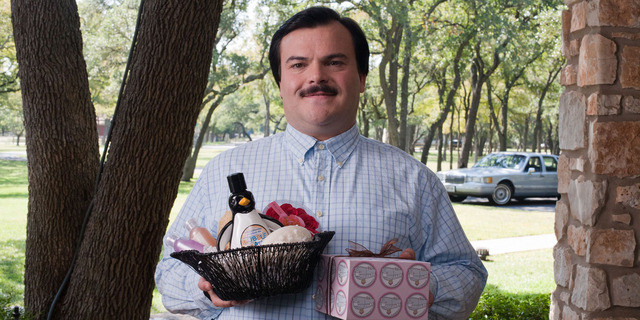
As for Black, he helps make Bernie into a fascinating character. Essentially, Bernie is this very odd, almost asexual guy who helps run the local funeral parlor. But he also leads church choir, directs and stars in local theater productions, and essentially devotes his life to improving the community. He's nice to everyone, and even if he's a little eccentric, everyone loves him and admires all the good that he does. Bernie even makes it a habit to visit the homes of the recently-widowed and present flowers and gift-baskets personally. It's in this way that he meets Marjorie - a mean, nasty woman who rejects Bernie's friendly gestures at first, but gradually warms up to his kindness and offers of companionship. Suddenly, the two become an unlikely pair of friends. But the friendship evolves into a weird, master-slave sort of relationship, as the ever-demanding and controlling Marjorie pushes the eager-to-please Bernie to his breaking point.
Back to Black though, he really is fantastic as Bernie. There's an amazing scene that opens the movie that really sums up the character, with Black demonstrating to a room full of students the proper way to dress a corpse for burial. Things that might gross out an ordinary person don't faze Bernie, and he meticulously attends to every detail of the dead body as if working on a painting for a gallery. Immediately, we realize that Bernie is sort of a strange fellow, but at the same time, you've got to admire his dedication to his craft. Soon, we begin to realize that that same dedication extends to everything that Bernie does.
A couple of other actors really stood out to me in this one. Aside from the amazing bit players who fill out the cast as interview subjects, a real highlight is Matthew McConaughey as Danny Buck, the smooth-talking lawyer who becomes a controversial figure when he becomes the man hired to prosecute Bernie. McConaughey is great here - and subtley hilarious. Buck, the alpha-male Texan, seems a bit baffled by Bernie's effeminate good-naturedness, and that makes him even more determined to see him put away. Meanwhile, as Marjorie, Shirley MacLaine is also excellent. Marjorie is a darkly comic character - just a horrible woman who only gets more horrible the nicer Bernie is to her.
Linklater crafts a quirky but very clever film here. So many movies are black-and-white moral exercises ... I found it fascinating to watch this story that poses the question - what if a man commits murder, but nobody could possibly blame him? Directed with a sharply satirical comic flair, and with a meticulous eye for detail, BERNIE is another fine film in Linklater's storied career.
My Grade: B+
Monday, December 24, 2012
KILLER JOE Is Sick and Twisted Fun
KILLER JOE Review:
- I love a great bugnuts insane movie, and KILLER JOE is exactly that. From director William Friedkin, the legend behind such classics as The French Connection and The Exorcist, Killer Joe is just a weird, depraved movie filled with pitch-black humor and some great performances. I wasn't expecting that. I knew little about the movie going in, and my impression was that this was some sort of dark crime flick. Little did I know that I was in for a movie that is dark, yes, but also balls-out crazy. Killer Joe isn't for everyone, but if you enjoy weird movies and want to take a walk on the wild side ... well, it's a must-see.
Adapted from a play by Tracy Letts, Killer Joe is film noir meets theater-of-the-absurd comedy meets grindhouse flick. In the film, we're introduced to a white-trash, trailer-park dwelling family in which each member seems to be various shades of mentally-ill. As the movie begins, the family's screw-up son, Chris (Emile Hirsch) - a low-level drug dealer, who's behind on his payments to a local crime-boss - convinces dimwitted dad Ansel (a fantastic Thomas Haden Church) to have mom killed. Word is she's got a hefty life-insurance policy, in which a large sum of money would, upon her death, go to spaced-out daughter Dottie (an equally awesome Juno Temple). Dottie agrees to go along with the plan, as does Ansel's current wife, the uber-trashy Sharla (Gina Gershon). Through his connections, Chris hires out a corrupt cop with a side-gig as an assassin, nicknamed Killer Joe (Matthew McConaughey). Joe at first glance seems like a slickly-efficient killer, but as the movie goes on, we realize that his services can come at a much higher price than you might have bargained for.
The ensemble cast in the film is top-to-bottom phenomenal. McConaughey is just doing killer stuff (pun intended) as Killer Joe - steely-eyed, cold, calculating, and yet - beneath the cool exterior, there's a total psycho waiting to come out. Haden Church is a great counterpoint to McConaughey - a weary, resigned schlub who finds himself in way over his head. Same goes for Hirsch as a scheming crook who only seems to stay alive due to his seeming harmlessness and modicum of charm. Gershon is also very game as Sharla, who is sort of the trailer-trash Lady Macbeth of the piece. I'll also single out Juno Temple as Dottie. Dottie is a strange character - almost absurdly innocent and childlike, yet right in the middle of some very nasty, traumatizing events and rather horrible people. Temple plays Dottie to perfection, making her both empathetic (if only she could get away from her horrible family!), and yet also sort of psychotic in her own right (her twisted relationship with Joe is downright disturbing).
Now, a movie like this can fall apart if it relies on shock value alone. But while KILLER JOE has plenty of totally over-the-top, jaw-droppingly strange scenes - it's also anchored by some fantastically sharp dialogue. This movie has a great script that's clever and incredibly funny. In fact, despite the film's dark, grim tone - I'd actually classify it as a comedy above all else. The dialogue is really spot-on though, and the exchanges between these well-defined characters tend to really crackle. There's an almost Coen Bros.-esque rhythm to some of the scenes.
As for Friedkin, he pulls no punches with the film - showing the various depraved acts that occur in the film in all of their glory (or lack thereof). But what I like is that he gives the movie a streamlined, tightly-woven feel - no wasted scenes, no fat to trim. The film just has a very assured quality to it - never trying too hard. Essentially, in the hands of a pro like Friedkin, Killer Joe avoids many of the traps that a movie like this might have encountered in less skilled hands.
It's rare that a movie like this seems to just sort of come out of nowhere and offer genuine shocks and surprises. But this is one of those movies that, if you're a film fan, you've just got to see to believe. This is a midnight movie classic, a film that will be watched for years to come in dorm-rooms and movie marathons (and yes, the rumors are true - you'll never look at KFC fried chicken the same way again after seeing this film). KILLER JOE is a killer flick - dark, weird, funny, badass, and a movie that needs to be seen to be believed.
My Grade: A-
Subscribe to:
Posts (Atom)