A Collection of Thoughts, Rants, and Reviews. Movies. TV. Games. Comics. Music. Pop-Culture. Follow Me On BlueSky, Threads, or Instagram.
Showing posts with label Ridley Scott. Show all posts
Monday, November 9, 2015
THE MARTIAN Is Sci-Fi With Smarts
THE MARTIAN Review:
- Legendary director Ridley Scott is perhaps best known for helming films that transfix with their arresting visuals, but that have a mythic, larger-than-life scope to their storytelling. With a few exceptions (Thelma & Louise comes to mind), his characters are more iconic than they are humane. Not that there's anything wrong with that - Scott ranks among my all-time favorite film directors, and his best movies (Blade Runner, Alien, Gladiator) are high on my list of best-movies-ever. But THE MARTIAN still feels like a departure - a movie that is at once huge, epic sci-fi but also very grounded, humane, and funny. Many of Scott's iconic films have a detached coldness to them. The Martian, in contrast, overflows with warmth. Give credit to the book from which the film is adapted, written by Andy Weir. But also give credit to the film's screenplay by Drew Goddard. Goddard, the Joss Whedon disciple who gave us smart and funny films like Cabin in the Woods, knocks this one out of the park. He finds both the epicness in the story and the humanity - and he differentiates THE MARTIAN from other recent space-exploration movies, like Gravity and Interstellar, by imbuing it with a sharp sense of humor and wit. What's more, whereas those other space epics ultimately veered into the more philosophical, spiritual, and cosmic, THE MARTIAN stays grounded in reality and science - presenting a story that has its share of far-fetched cinematic movie-moments, but that never strays from its pro-science message. In an age when we are often inundated - in pop-culture and politics - with figures obsessed with a view of humanity that puts supreme faith in the will of a higher power, it's refreshing (and timely) to get a sci-fi film that is so wholly about the can-do willpower and brainpower that each of us, innately, possesses.
Matt Damon plays astronaut Mark Watney, and it's one of the best performances of the actor's career to date. It may not be the type of performance that wins Oscars, but it's pure movie-star acting at its finest. Damon makes Watney into a supremely likable guy, a guy who, when he finds himself marooned on Mars after a mission-gone-wrong, smirks, rolls up his sleeves, and determines to "science the $%&#" out of his dire-seeming situation. Watney is in many ways an everyman - but a very smart and capable everyman. He's a botanist who has ideas about how to create sustainable food that can ensure his survival for a longer-than-anticipated period of time. He's a doer. He's the kind of guy whose ingenuity makes the higher-ups at NASA - and his fellow crew members - willing to risk a hell of a lot to get him home.
In many ways, the conversations back on earth, at NASA, are as interesting and tension-filled as Watney's struggle to survive on Mars. It helps that the supporting cast here is absolutely stacked, bringing just the right combo of gravitas and good-natured humor to the proceedings. Jeff Daniels is great as a NASA director with the weight of the world on his shoulders - answerable to his bosses and to the public and press, but also keen to bring his man home. Chiwetel Ejiofor is another NASA official who pushes on Daniels to do everything possible to save Watney. Sean Bean is also in the mix. Did I say gravitas? There are also really great small-but-pivotal roles for people like Donald Glover, Mackenzie Davis, and Benedict Wong - each helping to round out the NASA tech team. Similarly great is the supporting cast that fills out Mark's space-flight crew - who leaves him stranded on Mars after believing him to have died in a violent storm. Jessica Chastain is one of the absolute best actors working today - and she kills it as Melissa Lewis, the ship's captain and the leader of the effort to bring Mark back. Chastain - now apparently the go-to woman to help you get un-lost in space - really kicks ass here. She takes a role that could have been un-memorable and makes it one of the movie's best. Michael Pena has brought the funny to a number of recent blockbusters (see also: Ant-Man), and he's an unsung hero here as a member of Chastain's crew. Kate Mara is also rock-solid, as are Sebastian Stan and Aksel Hennie.
Ridley Scott is one of the best-ever at doing eye-popping sci-fi visuals, and he doesn't disappoint here. Often, his filmmaking seems a little more restrained and grounded to match the script's lighter tone. But Scott cranks it up to eleven when called upon. He delivers sweeping Martian vistas, claustrophobic shuttle interiors, and a rip-roaring, edge-of-your-seat outer-space finale that truly demands to be seen on the biggest screen possible. And yet, he doesn't let those killer visuals detract from or overwhelm the movie's smaller and more intimate moments. This is a film that gets almost as much oomph from crop-growing and message-decoding as it does from zero-gravity space rescues.
Scott is a filmmaker whose sci-fi films I associate with darkness. Alien showed us absolute terror in a dystopian and derelict future. Blade Runner showed us a rain-soaked Frankenstein-monster nightmare of technology gone wrong. But THE MARTIAN distinguishes itself by being an old-fashioned, gung-ho movie about the power of human ingenuity - one that also happens to be one of the most exciting, nail-biting, and visually-stunning films of the year so far. It's spectacle with smarts, sci-fi that actually embraces science.
My Grade: A-
Tuesday, December 16, 2014
EXODUS Is Dazzling But Ultimately Hollow Biblical Epic
EXODUS: GODS AND KINGS Review:
- Let me start with this: Ridley Scott is one of the greatest filmmakers of all time. His list of stone-cold classics is long - he's directed not only some of the best, but most influential movies ever made: Alien, Blade Runner, Thelma & Louise, Gladiator. The guy is a legend (and he also directed Legend), and yet, in my opinion, he rarely gets a fair shake these days. People seem eager to take him down a peg, and critics seemed all-too-eager to bash his latest, EXODUS, before they'd seen it. There was a lot of early talk about the film's seemingly whitewashed cast, a controversy that continued up to and through the film's release. And Scott did himself and his movie no favors with his gruff, ill-advised response to the criticisms. Here's my thought: the casting in this film feels decidedly "off," and it is an issue that filmmakers need to seriously look at as they go into production on a movie. In 2014, we are more than ready for more diverse casts - in general, and notably in situations where the setting and characters are *supposed* to be non-white. It's strange and slightly troubling that all of the key Egyptian characters in EXODUS are played by white actors. That said, I also don't think that this is an issue that needs to completely dominate discussion of the film. Sadly, diversity (or lack thereof) is an issue that plagues many, many movies. I could start any number of reviews with a dissection of the film's casting from a diversity-perspective, but going down that road can often lead to an exercise in absurdity. Clearly, there are cases where casting crosses a line of inappropriateness. But where, exactly, is that line? EXODUS arguably toes it - but I also am not sure that it crosses it in egregious enough fashion to warrant true outrage, calls for boycotts, etc. I won't go into my exact reasons here. I'll simply say this: Scott and the rest of his team could have done better - they could have created this movie with more of an eye towards diverse and appropriate casting. But I also don't think that that these concerns need to negate all other discussion of the film. There's plenty more to talk about, and from here on out ... that's what I'll attempt to do. I'll just end with this: I suppose my original thought here was - as a huge fan of Scott, I'm not yet ready to burn him at the stake for some ill-advised decisions and comments. The man has done great films with diverse casts in the past. He helped bring to life one of the greatest female action heroes in cinematic history in Ellen Ripley. I think he can and will do better.
So ... EXODUS. In a year in which we've already seen one epic retelling of an apocalyptic bible story in Noah, Exodus arrives clearly ready to awe us with big, blockbuster visuals and a fantasy-epic take on the story of Moses. As compared to the trippy, surreal Noah, EXODUS is by far the more straightforward of the two films. The problem is it may be *too* straightforward. The film goes to some very dark thematic places, and poses a lot of tough questions about the nature of the old-testament God and the justness of the devastation he wreaks upon the Egyptians. But the film barrels forward at such a determined clip - trying to cover as much ground as possible in its 2 1/2 hour running time - that it rarely pauses to fully address the complicated questions of morality and faith it puts out there to us (Noah, in contrast, is almost fully *about* grappling with these questions).
In EXODUS, God takes the form of a wide-eyed ten-year-old British boy, who speaks to Moses in visions with an ominous, anger-laced, almost eerie sense of righteousness. This is a God who doesn't mince words, who shows no mercy, no quarter, and no pity, and who seems to spite the Egyptians for the fact that they worship other, false gods. In other versions of the Exodus story (i.e. The 10 Commandments), the Egyptians' faith in their gods seems affirmed by magical abilities (see: the famous scene, drawn from the bible, in which the Pharoah's magicians turn their staffs into serpents). But in EXODUS, the Egyptian gods are shown to be false: there are no magic powers, prayers to them prove ineffectual, and even the Egyptians seem less-than-confident in their potency. In fact, the Egyptians prefer science over faith - as the ten plagues devastate their people, Ramses II listens intently as a scientist provides logic-based explanations for the various afflictions befalling their people. Only when the plagues escalate - culminating with the killing of the Egyptians' first born - is there no denying that the plagues are in fact the works of a vengeful, all-powerful god.
In Noah, the devastation of the flood took on a new horror thanks to the visual force of modern f/x. The same is true here, as the plagues truly feel horrific and bloody and nightmarish. It's one thing to read vague bible verses listing out the plagues in sequential order. But to see rivers run red with blood, locusts devouring crops, total darkness, and firstborn children dying suddenly in the night ... well, it's a lot. Scott assaults us with the plagues, and does so without interjections in which Moses is shown asking Ramses to "let my people go." And so, the plagues come off as a merciless, genocidal punishment. Sporadically, Moses does question their ferocity.
But only sporadically, and soon enough, the questioning stops - Moses becomes God's loyal messenger, and the film seems to stop grappling with the concepts it had previously put out there. Ultimately, EXODUS comes across as thematically thin - we don't get a great sense of what drives Moses, what drives Ramses II, and what drives this version of God who is the film's most intriguing, yet elusive, character.
Christian Bale is excellent as Moses. Bale was born to do epic, and so he's a natural to be this most epic of characters. Bale gives a great sense of gravitas to numerous scenes - whether it's stopping an accusatory Ramses from lobbing off his sister's hand, to training the Hebrews to fight as an army, to commanding his people to have faith and cross the seemingly-uncrossable Red Sea. Moses is most intriguing though in the film's early going, when the script takes its time and effectively establishes the strong but slowly fraying relationship between Ramses and his adopted brother Moses. This entire early portion of the film is perhaps its strongest - early on, the movie takes its time and builds up the relationship and rivalry between Moses and Ramses, and this unique look at their relationship is compelling stuff. Later, however, the film leapfrogs through large portions of Moses' story. His relationship with his eventual wife, Tziporah, for example - Moses meets her while in exile, she gives him some furtive glances, and moments later they're exchanging vows and declaring their undying love for each other. Also rushed through is Moses' reaction to meeting his long-lost brother, Aaron - there is none, really. It's indicative of the movie's tendency to present something tantalizing but then brush over it without a real narrative or emotional payoff.
Joel Edgerton is getting the most flack from industry-watchers for being cast as Ramses II. He's a pale Australian playing an Egyptian pharaoh. However, that issue aside, he's great in the film. He plays Ramses II as a preening narcissist, a dude who broods whilst wrapped in a giant python. Edgerton has quickly become a favorite actor - I'd yet to see him play a villain, but he excels at it here, and is a co-MVP of the film along with Bale. Whitewashing aside though, the movie does have some oddball casting going on. Notable actors like the great Sigourney Weaver pop up (in her case, as Ramses' stone-faced mother), but barely make an impact. Same goes for Aaron Paul as Moses' right-hand-man Joshua, whose role is more extended cameo than anything of substance. Ben Mendelsohn is good as a corrupt Egyptian viceroy - a source of some rare humor in the film. But even Ben Kingsley seems adrift as an elder Hebrew, whose main role is to reveal to Moses his true origins.
This is, ultimately, the story of Bale's Moses vs. Edgerton's Ramses. And the movie does a nice job of setting both up for a battle of wills, culminating in a truly epic confrontation in the midst of the parting Red Sea. And Bale and Edgerton make for great adversaries - both act the hell out of their parts. The problem is that the bigger story around them gets glossed over -, and the larger themes raised by the story largely ignored - so that the film can focus primarily on its central brother vs. brother confrontation. It's a fine angle to take on the story. But this story, I think, demands something more. It's one of the defining stories about a vengeful God in the old testament. And Moses' role as God's messenger feels like it isn't explored to its fullest potential here. The fact is, the biblical story is in many ways a head-scratcher. And so part of the purpose, to me, of re-imagining this sort of story is to attempt to make sense of the narrative's lessons. How are these ancient stories relevant to us today? To reduce this story - with all of its complex questions of morality, faith, etc. - to a more standard war epic makes this movie feel less-than-necessary. The bible is allegory, and the allegory seems mostly lost here. And so, those looking for insight or meaning in this movie may not find much of it.
What they will find is a film that is truly eye-popping from a visual perspective. Scott is a master of creating rich, evocative visuals - and this movie looks amazing. In 3D, in particularly, the Egyptian landscapes come to life with towering structures, sweeping deserts, massive crowds filled with all manner of lavish costuming, and ornately-decorated palaces and halls that make Game of Thrones look like Days of Our Lives. This is old-school epicness, and the grandeur is often awe-inspiring. Scott also delivers big-time on the big f/x. The plagues are visceral and haunting. The precursor to the plague of Blood involves packs of rabid crocodiles chomping down on people and animals and leaving the water red with their remains - all conveyed in a fantastically-realized sequence. The parting of the Red Sea here feels truly, awesomely epic. Everything in EXODUS looks like a million bucks, and every penny of the film's budget is seemingly there on screen.
Scott is still the absolute best in the biz at epic visuals - even when burdened with problematic scripts, a Ridley Scott epic is always worth seeing on as big a screen as possible. Strangely, that's why a comparison between EXODUS and Prometheus may be warranted. Like Prometheus, EXODUS is mesmerizing to look at. But also like Prometheus, the film introduces *big* questions that it sort of shies away from as the movie progresses - leaving the film feeling oddly hollow.
Like I said, I am not about to count out Ridley Scott - either as a filmmaker or as a person worthy of admiration. EXODUS nails the visuals, but, like a few of other Scott's recent films, a combination of script and overall storytelling issues keeps the movie from achieving the iconic thematic resonance of classics like Alien, Blade Runner, and Gladiator. Still, Scott's visual imagination makes his movies must-sees for film fans - even when not firing on all cylinders, there is enough here to remind us why he's one of the best.
My Grade: B
Monday, June 11, 2012
PROMETHEUS - Ridley Scott's Mesmerizing Yet Frustrating Return to Sci-Fi
PROMETHEUS Review:
- This is going to be a hard review to write. The fact is ... I immensely enjoyed Prometheus. In some ways, it completely blew me away, and from a purely visual/aesthetic viewpoint, it was one of the most spectacular and beautiful films I've seen ... ever. And there were ideas here that I loved, moments that were mesmerizing and memorable. Just sitting back and watching this film in glorious IMAX 3D and being swept away by its grim and majestic sci-fi universe ... was one hell of an experience at the movies.
And I've been thinking about PROMETHEUS. Since I saw it, I've been rolling it over in my head. I want to make some sense of it - I want to believe that the film is great and that it simply demands multiple viewings to fully comprehend. But I've come to realize that this is a film that simply has to be taken down a peg for its flawed storytelling. Even though I was able to "just go with it" for much of the movie, this is indeed a film that arrives to us diminished from what it might have been.
The thing is ... Ridley Scott became a sci-fi icon on the backs of films that told stories in broad, at times almost abstract strokes. Alien, Blade Runner, Legend ... these are films that have a lot of ambiguity and that leave much to the viewer's imagination. They are films more about ideas and imagination and visual world-building than complex plotlines. And that's what makes them so resonant and captivating. Prometheus is almost the equal of those films in terms of sheer sense of imagination and visual wonder. Of course, Blade Runner and Alien never had the advantage of coming out in IMAX 3D. Prometheus, meanwhile, has perhaps the best use of 3D yet in any live-action film - silky smooth and seamless, yet completely immersive. But, back to the storytelling ... what's so frustrating is that Prometheus COULD have been a simple and more abstract story if told in a slightly different manner. But writer Damon Lindeloff had a couple of major obstacles in terms of crafting the script: a.) he was tasked with creating a story that - seemingly more for commercial reasons than anything else - had to tie-in to the mythos and continuity of the Alien films, and b.) he had to grapple with his past history as a TV writer and as a writer of highly episodic, serialized content.
Because, man, PROMETHEUS feels in a way like an incredible TV pilot. But as a movie, that means it's less than fully satisfying. The problem is, Lindeloff structures the plot like an episode of LOST. Throughout the film's running time, questions are posed that seem to demand specific answers: Why did one character betray another? Why were certain secrets kept? What are the true motivations of various characters? What is the explanation behind some of the various creatures that terrorize the cast - how did they come to be? Now, the movie COULD have been written in a manner so as not to pose these sorts of specific questions. But instead, it's LOST all over again ... one shoe drops, but the other shoe doesn't. The whole plot is built around key question marks practically flashing on the screen - "why did he do that?", "where did those come from?" - but they all end up being red herrings, because the payoffs never come. I've been thinking a lot about the film, as I said, and trying to figure out what IS in the movie and what ISN'T. Some may say "it's all in the movie." But that simply isn't true. And that's frustrating, because there's no room for interpretation - ALL interpretations are equally valid because we just don't have enough information to posit anything except pure guesses. And at some point, you have to wonder: how much of Prometheus was meant to be ambiguous, and how much of it simply got gutted in the development process? At what point do you draw the line between feeding an audience's imagination, and simply crafting a film that's full of swiss cheese-esque holes?
Ridley Scott is no stranger to these sorts of debates. BLADE RUNNER contains one of the all-time most talked-about ambiguous endings in film. But the genius of that ambiguity is that it presents us with two possibilities - each casting the story and the character of Deckard in a different light. Is Deckard a replicant, or isn't he? But Prometheus never sets up that sort of narrative framework to go off of. I'll talk more about the plot in a second, but I'll just quickly mention the arcs of two key characters: Weyland - an elderly CEO and billionaire (Guy Pierce) who travels the cosmos in search of the key to eternal life, and David - an android who serves Weyland. In short, we're left to infer just about everything about these characters and the motivations behind their actions. It hurts, because both are potentially awesome characters. Michael Fassbender in particular plays David so well - he kicks ass. But why does David do the things he does in the movie? I have no idea. I can guess - there are a dozen possible and sort-of plausible reasons. But we just don't know, and the answers aren't between the lines either. But what's weird is that Scott and Lindeloff seem to *want* to say something profound with David. They clearly want us to - through him - think about life and death and creation and destruction and good and evil. But David ends up as a total cypher - we want to latch on to this amazing performance from Fassbender, but we end up just transplanting concepts from other stories about robots and artificial life onto his character - because he's such a blank canvass. Now again, in the original ALIEN, there was an android character who played a similar role. But let's face it, Ash in Alien - and Alien as a whole - never had much pretension of being the sort of philosophical mind-trip that Prometheus wants to be. Alien just wanted to be a futuristic survival movie, thick with atmosphere, that scared the hell out of you. Prometheus is trying to be more than just a horror flick. It aims to be about life, the universe, and everything ... but at that, it only partially succeeds.
So let's back up for a minute, and talk about the plot of Prometheus. Essentially, this is the Alien-verse, but in a timeframe just prior to Ellen Ripley's infamous encounter with the deadly xenomorphs aboard the Nostromo. Where we're at now is the several decades in the future, at a time when huge advances have been made in space travel. Even as humans now have the capability to explore deep space, a quest comes up worthy of our newfound capacity for insterstellar discovery. A husband-and-wife team of scientists - Elizabeth Shaw (Noomi Rapace) and Charlie Halloway (Logan Marshall-Green) - has been tracking ancient etchings across the globe, and have found common-denominator depictions of godlike alien beings descending from the heavens. Accompanying each of the etchings is what the scientists believe to be a star map. Now, they are convinced that they've found a roadmap to another civilization - a civilization that just might be our creators, our gods. They've also conviced Peter Weyland, an aging innovator whose company seems to have pioneered advances in both robotics (producing a line of lifelike androids) and space travel/exploration. Weyland funds a journey to the stars in search of the alien beings and their secrets. He deploys Weyland Corp. representative Meredith Vickers (Charlize Theron) to oversee the scientists and their mission. Vickers, Shaw, and Halloway are also accompanied by a crew that includes Janek (Idris Elba) - the ship's world-weary captain, an erratic geologist named Fifield, and David - Peter Weyland's personal android assistant, who oversees the ship while the crew goes into hypersleep for the bulk of their journey.
What more you need to know is simply that the name of the ship is Prometheus, named after the Titan of myth who sought the secret of fire and got burned for his hubris. Very quickly, amidst mixed motivations both spiritual, scientific, and corporate, we realize that the crew of the ship Prometheus may be in for more than they bargained for with this mission.
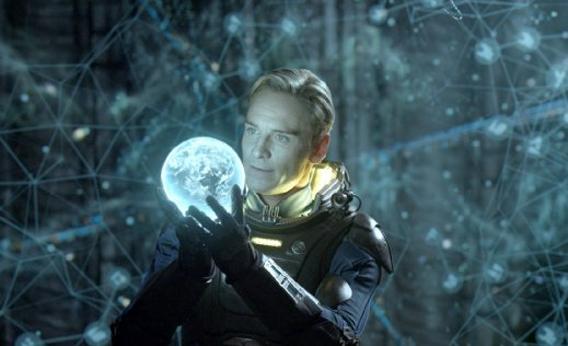
The thematic scope of Prometheus is vast and epic. While ALIEN only hinted at its larger universe, Prometheus tries to define the very nature of the universe itself. The movie even begins with a mesmerizing Genesis scene that is its own alien-infused version of the creation myth. Soon enough, the film hints at revelations about not just the iconic aliens of ALIEN, but of the secret origins of ALL life. Yep, this is one cosmic, grand, ambitious film. And honestly, there are two areas where Prometheus absolutely excels. One is when it's simply in planetarium mode, dazzling us with sprawling alien landscapes, burning our retinas with eye-melting techno-wizardry, and sweeping us off our feet with grand visions of the far reaches of outer space. Ridley Scott, at 74, is still THE MAN when it comes to crafting evocative sci-fi visuals. And with this film, he also proves to be the anti-Michael Bay. Those of the ADD generation may not have the patience for the methodically-paced opening act of the film, but I loved it. I loved that Scott lingers and lets us soak up the epicness, and immerse ourselves in this cosmic playground. The semi-retro-sounding, epic-cosmic score only adds to the grandeur, with bombastic, haunting tones that give the film even more of a larger-than-life, operatic feel. Forget for a moment every critique I mentioned earlier - story complaints aside, make no mistake - Prometheus is pure audio/visual awesomesauce. The brilliant visuals here deserve an Oscar. The score is fantastic. And Ridley just directs the hell out of this film as only he can. The man knows how to create a mood of foreboding otherworldliness, and he does so here in legendary fashion. The images that this film assaults you with are truly the stuff that dreams - and nightmares - are made of. The CGI is elegant and artful, and the shot composition is crafted for maximum impact. On that note, the second area where the film really nails it is in the Alien-esque moments of action-horror. Scott crafts some true holy $%&#, nightmarish moments of otherworldly terror, and when business picks up, the movie delivers with some crazy human vs. creature showdowns that will leave your jaw hanging.
As mentioned, there are so many little moments in the film that are GREAT. Some of these moments are quiet and contemplative ... Fassbender as David watching Laurence of Arabia and trying to emulate it ... Idris Elba being badass and telling Charlize Theron what's what ... an absolutely incredible sequence where David uncovers the secrets of the alien race that the crew has sought out, and is literally surrounded and engulfed by the knowledge of the ancients. On the other hand, some of thes film's great moments are balls-to-the-wall insane ... a riveting and squirm-worthy scene of Noomi Rapace having to self-operate ... and a final, Alien-esque showdown with a hideous Lovecraftian monster.
I also thought that most of the cast was excellent, even if their characters had rather thin backstories at times. Rapace was quite good in the lead. Theron was suitably cold and calculating. Elba was a badass. Marshall-Green seemed a little in-over-his-head though. And Guy Pierce, while good, was hampered by some very odd f/x to make him seem aged.
So I'll be honest ... in writing this review, I was hoping that I'd come to some sort of internal consensus about the film. But now that I've talked about its merits and its flaws, I still feel torn. Prometheus is an incredible, state-of-the-art aesthetic experience. I can't recommend enough going to see it in the theater on the biggest and best screen possible - and yes, in 3D. And I also give it credit for being so thematically ambitious and daring. This is a movie that's going to be talked about and debated for a long, long time. And of course, you never know ... a sequel that follows up on some of the questions posed here, or even a couple of choice re-inserted or re-cut scenes (there's already talk of a director's cut on blu-ray) could be enough to force a reexamination of the film and force it to be looked at in a different context. But who knows. Was this film intended to be Part 1 of a multi-part epic? If viewed as the first chapter of a serialized story, then hey, a lot of my concerns might be a moot point. I also dont know if this is simply a film that got hacked to bits by the studio. We all know that Ridley Scott has a long history of having his films butchered upon release. And yet ... I've seen some interviews with Scott and Lindeloff, and I haven't seen any comments in the vein of "what happened was ____, and don't worry, that will be further followed up on in the imminent sequel." And then I also think back on LOST, and think about how that show was so effective at posing questions, yet ultimately - frustratingly - unable to provide satisfying follow-through. And I can't help but wonder if Prometheus is a similar beast - a movie so wrapped up in building up its mysteries that it forgets that mysteries alone don't make for a satisfying narrative. But as I said, it's extra-frustrating because the aesthetics of the film are so strong, so powerful on their own, that the film probably would have worked better had it been *more* minimalist. Instead, it feels like the plot is only given to us in half-measures - wanting to craft a cosmic mythology, but not having the vision to go all the way. Prometheus is so close to being a classic that it hurts. And I may just end up having a soft spot for it over time ... we'll see. But right now, my feelings are too conflicted to call Prometheus unequivically great, given the less-than-wholly-fulfilled potential of Ridley Scott's return to the world of science fiction. That said - Sir Ridley - more, please. You're too brilliant of a filmmaker not to return to this genre, and Prometheus teases us that, with the right script, Scott can still be as good as ever.
My Grade: B+
Subscribe to:
Posts (Atom)