Wednesday, December 26, 2012

BERNIE Is Clever Comic Satire


 BERNIE Review:

- Bernie is a really cool little movie from Richard Linklater, a director whose work I always admire and who never fails to take chances and dare to be different. With BERNIE, Linklater re-teams with his School of Rock star Jack Black, but this time, Black plays very much against type. Black is Bernie Tiede, a sweet, soft spoken, kindly, beloved pillar of his community - the tight-knit community of Carthage, Texas. This darkly comedic film - based on a true story - explores what happens when Bernie, Carthage's favorite son, is accused of murdering bitter, mean old Marjorie Nugent, its most hated woman. Linklater weaves a meticulously-crafted, pitch black, Southern-fried satire here - crafting a memorable morality play that also bursts at the seams with local flavor and detail.

Bernie is shot in a blend of styles. We see the action play out in a series of flashbacks to various points in Bernie's life in Carthage, but the entire narrative is framed with mockumentary-style talking heads, used as a Texas-sized Greek chorus of commentators. As the revolving cast of Carthage locals provide their recollections of Bernie, we'll flash to those moments and see them play out. What makes this work so well is just how authentic-seeming it all is. The characters are over-the-top and exaggerated, sure, but there's also a lovingly-specific quality to them that brought to mind the eccentrics of Christopher Guest's various mockumentary films. It doesn't hurt that all of the actors that portray the interview subjects are just fantastic. I'm not sure to what extent any of them are locals, but it sure feels like most of them are.

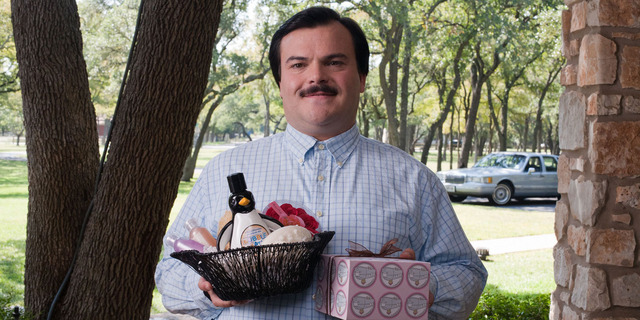
As for Black, he helps make Bernie into a fascinating character. Essentially, Bernie is this very odd, almost asexual guy who helps run the local funeral parlor. But he also leads church choir, directs and stars in local theater productions, and essentially devotes his life to improving the community. He's nice to everyone, and even if he's a little eccentric, everyone loves him and admires all the good that he does. Bernie even makes it a habit to visit the homes of the recently-widowed and present flowers and gift-baskets personally. It's in this way that he meets Marjorie - a mean, nasty woman who rejects Bernie's friendly gestures at first, but gradually warms up to his kindness and offers of companionship. Suddenly, the two become an unlikely pair of friends. But the friendship evolves into a weird, master-slave sort of relationship, as the ever-demanding and controlling Marjorie pushes the eager-to-please Bernie to his breaking point.

Back to Black though, he really is fantastic as Bernie. There's an amazing scene that opens the movie that really sums up the character, with Black demonstrating to a room full of students the proper way to dress a corpse for burial. Things that might gross out an ordinary person don't faze Bernie, and he meticulously attends to every detail of the dead body as if working on a painting for a gallery. Immediately, we realize that Bernie is sort of a strange fellow, but at the same time, you've got to admire his dedication to his craft. Soon, we begin to realize that that same dedication extends to everything that Bernie does.

A couple of other actors really stood out to me in this one. Aside from the amazing bit players who fill out the cast as interview subjects, a real highlight is Matthew McConaughey as Danny Buck, the smooth-talking lawyer who becomes a controversial figure when he becomes the man hired to prosecute Bernie. McConaughey is great here - and subtley hilarious. Buck, the alpha-male Texan, seems a bit baffled by Bernie's effeminate good-naturedness, and that makes him even more determined to see him put away. Meanwhile, as Marjorie, Shirley MacLaine is also excellent. Marjorie is a darkly comic character - just a horrible woman who only gets more horrible the nicer Bernie is to her.

Linklater crafts a quirky but very clever film here. So many movies are black-and-white moral exercises ... I found it fascinating to watch this story that poses the question - what if a man commits murder, but nobody could possibly blame him? Directed with a sharply satirical comic flair, and with a meticulous eye for detail, BERNIE is another fine film in Linklater's storied career.

My Grade: B+

Monday, December 24, 2012

KILLER JOE Is Sick and Twisted Fun


KILLER JOE Review:

- I love a great bugnuts insane movie, and KILLER JOE is exactly that. From director William Friedkin, the legend behind such classics as The French Connection and The Exorcist, Killer Joe is just a weird, depraved movie filled with pitch-black humor and some great performances. I wasn't expecting that. I knew little about the movie going in, and my impression was that this was some sort of dark crime flick. Little did I know that I was in for a movie that is dark, yes, but also balls-out crazy. Killer Joe isn't for everyone, but if you enjoy weird movies and want to take a walk on the wild side ... well, it's a must-see.

Adapted from a play by Tracy Letts, Killer Joe is film noir meets theater-of-the-absurd comedy meets grindhouse flick. In the film, we're introduced to a white-trash, trailer-park dwelling family in which each member seems to be various shades of mentally-ill. As the movie begins, the family's screw-up son, Chris (Emile Hirsch) - a low-level drug dealer, who's behind on his payments to a local crime-boss - convinces dimwitted dad Ansel (a fantastic Thomas Haden Church) to have mom killed. Word is she's got a hefty life-insurance policy, in which a large sum of money would, upon her death, go to spaced-out daughter Dottie (an equally awesome Juno Temple). Dottie agrees to go along with the plan, as does Ansel's current wife, the uber-trashy Sharla (Gina Gershon). Through his connections, Chris hires out a corrupt cop with a side-gig as an assassin, nicknamed Killer Joe (Matthew McConaughey). Joe at first glance seems like a slickly-efficient killer, but as the movie goes on, we realize that his services can come at a much higher price than you might have bargained for.

The ensemble cast in the film is top-to-bottom phenomenal. McConaughey is just doing killer stuff (pun intended) as Killer Joe - steely-eyed, cold, calculating, and yet - beneath the cool exterior, there's a total psycho waiting to come out. Haden Church is a great counterpoint to McConaughey - a weary, resigned schlub who finds himself in way over his head. Same goes for Hirsch as a scheming crook who only seems to stay alive due to his seeming harmlessness and modicum of charm. Gershon is also very game as Sharla, who is sort of the trailer-trash Lady Macbeth of the piece. I'll also single out Juno Temple as Dottie. Dottie is a strange character - almost absurdly innocent and childlike, yet right in the middle of some very nasty, traumatizing events and rather horrible people. Temple plays Dottie to perfection, making her both empathetic (if only she could get away from her horrible family!), and yet also sort of psychotic in her own right (her twisted relationship with Joe is downright disturbing).

Now, a movie like this can fall apart if it relies on shock value alone. But while KILLER JOE has plenty of totally over-the-top, jaw-droppingly strange scenes - it's also anchored by some fantastically sharp dialogue. This movie has a great script that's clever and incredibly funny. In fact, despite the film's dark, grim tone - I'd actually classify it as a comedy above all else. The dialogue is really spot-on though, and the exchanges between these well-defined characters tend to really crackle. There's an almost Coen Bros.-esque rhythm to some of the scenes.

As for Friedkin, he pulls no punches with the film - showing the various depraved acts that occur in the film in all of their glory (or lack thereof). But what I like is that he gives the movie a streamlined, tightly-woven feel - no wasted scenes, no fat to trim. The film just has a very assured quality to it - never trying too hard. Essentially, in the hands of a pro like Friedkin, Killer Joe avoids many of the traps that a movie like this might have encountered in less skilled hands.

It's rare that a movie like this seems to just sort of come out of nowhere and offer genuine shocks and surprises. But this is one of those movies that, if you're a film fan, you've just got to see to believe. This is a midnight movie classic, a film that will be watched for years to come in dorm-rooms and movie marathons (and yes, the rumors are true - you'll never look at KFC fried chicken the same way again after seeing this film). KILLER JOE is a killer flick - dark, weird, funny, badass, and a movie that needs to be seen to be believed.

My Grade: A-

THE GUILT TRIP Is Good-Natured Schmaltz


 THE GUILT TRIP Review:

- The Guilt Trip is pretty much what it seems - a fun, semi-schmaltzy, relatively inoffensive road-trip movie that pairs Seth Rogen, as the schlubby son, with Barbara Streisand as his naggy, overbearing Jewish mother. The movie is well-crafted, funny, and entertaining - though it's so mild that it also never really goes from chuckle-worthy to hilarious. This is a movie that Jewish mothers everywhere will probably love, and their Jewish sons (like me) will enjoy, but that will cause them to wonder when Seth Rogen's next edgier, more vulgar film (i.e. - one their mothers would hate), will arrive in theaters.

Of course, The Guilt Trip has to ride a fine line - because look, I can handle zombies, vampires, serial killers, and psychos - but seeing a Jewish mother on the big-screen, depicted in all her guilt-giving, overprotective, gleaned-from-Good Housekeeping-and-Oprah advice dispensing, confidence-depleting glory - well, that for me was *truly* scary. I mean, there's a moment in THE GUILT TRIP where Seth Rogen, pushed to the limit by his never-silent, always-nagging mother finally snaps, and just yells at her to shut up. Some audience members gasped, but I could only nod my head in painful recognition. This. right here, was Exhibit A for why generations of young Jewish boys have moved to LA and become neurotic writers.

Luckily, The Guilt Trip eases the pain by gradually softening Streisand's character and putting her through her paces. The story involves Rogen as Andy, a 30-ish single guy who lives in California, and has put his time and money into developing and trying to sell an organic cleaning fluid. Andy's future rests on what happens during an upcoming cross-country road-trip, where he's booked himself meetings with big chain stores like Walmart and CostCo to see if they'll agree to carry his product. Before he starts the trip, Andy stops back east to visit with his widowed mom, Joyce (Streisand). Andy is fed up with his mom within hours of being home, but then, a story she tells him gives him pause. Joyce confides in her son that, before meeting his father, she had a first love who she'd since lost track of, but still thought of fondly. Andy tracks down the guy, and finds out that he lives in Sacramento. Thinking that finding this long-lost love might be the key to finding happiness for his long-suffering mother, Andy - against his better judgement - invites his mom to come along on his road-trip, holding off on revealing his ulterior motive. And so the two set off cross-country, and booth soon find themselves well out of their comfort zones.

To screenwriter Dan Fogelman's (Crazy Stupid Love) credit, he seems to hit at all the right pain points that make any Jewish boy (or anyone with overbearing parents) cringe in recognition. Streisand's Joyce, of course, ends up interfering and screwing up her son's big meetings, forcing him to awkwardly listen to a "Middlesex" book-on-tape during their car-ride (Rogen promptly switches it off every time genitals get mentioned), and keeps prying into her son's dating life - forcing an awkward reunion with an old girlfriend in the hopes of playing yenta. But again, Fogelman also humanizes Joyce by having her find her inner shiksa and loosen up a bit as the movie goes on. It's a lot of fun to watch as Streisand gets wasted, enters an eating contest at a down-home Texas BBQ joint, and flirts with a very goyish cowboy who seems to fancy her.

Both Rogen and Streisand are quite good here. If anything, Streisand is a little *too* on-the-nose with her portrayal of Joyce, and tends to make her a little less sympathetic and more annoying than she probably should be. I'm never a proponent for watered-down characters - but man, Barbara truly is terrifying when she's in full swing. Like, enough where Jewish dudes may be cancelling J-Date subscriptions after seeing this movie and wondering if this is what they're in for. That said, her comic timing is pretty impeccable, and she and Rogen do a great job riffing off of one another (be sure to stay for the credits, where there are some truly hilarious outtakes of the two of them improvising). And Rogen is actually really really good here - handling both the comedic and dramatic parts of the film exceptionally well. This reminded me why Rogen is so good - because he can mix very dry, acerbic humor with a real sincerity. He has some fantastic, extremely funny line deliveries in the film. And, because most of the movie is relatively PG, on the occasions that Rogen does get a bit R-rated, it's extra-shocking and funny.

The movie also features some welcome cameos to spice things up a bit. Adam Scott, Yvonne Strahovski (making me really miss CHUCK), and Colin Hanks all appear. And director Anne Fletcher gives the movie a classic, 80's-ish road-trip flick sort of feel.

In any case, this is a nice little feel-good, good-natured comedy film. Just enough bawdy humor for Rogen fans, and just enough aw-shucks sweetness to make Streisand fans swoon and possibly shed a tear or two (moms everywhere may get a little verklempt). In short, the perfect film to take the mishpacha to following Chinese food on Christmas. And yeah, you gentiles (oy) might find this a fun / funny movie as well.

My Grade: B

Sunday, December 23, 2012

JACK REACHER Is Retro Action Movie Comfort Food


JACK REACHER Review:

- Jack Reacher is one of the most by-the-numbers, predictable action flicks I've seen in a long while. But there's also an undeniable comfort-food aspect to the film, and several moments of over-the-top coolness. What's so strange is that the movie feels like it came out of a time-warp from some long-ago land of Hollywood crime capers. It's definitely a throwback, coming off as a mash-up of everything from Bullit, to Dirty Harry, to Rambo, to 90's procedural thrillers like Kiss the Girls. And Jack, as a character, is sort of a mash-up of all those action-movie archtypes - he's got the smoothness of Bullit, the mean streak of Dirty Harry, and he's an ex-military lone-wolf drifter like John Rambo. So JACK REACHER comes off as feeling a bit bland at times, except that it's got just enough badassery to make it perfect for a rainy afternoon. What I'm saying is - prepare to catch this one on TNT many, many times in the years to come.

Now, one weird thing about JACK REACHER is that the title character, from the books, is supposed to be this big, burly, grizzled badass who stays off the grid and answers to no one. Essentially, this would have been the perfect vehicle for an 80's or 90's-era Kurt Russell. But instead, we get the 50-ish but still lean and boyish Tom Cruise in the part, and it makes for an odd contrast with the material. So much of the dialogue, as written for the screen by writer/director Christopher McQuarrie ... you can hear how it would sound pretty badass if delivered in a Snake Plissken-esque growl. But from the mouth of Cruise, a lot of it lacks much bite. So some of the lines that might otherwise have been grimly funny end up falling a bit flat. The funny thing is that lead actress Rosamund Pike, playing a crusading lawyer, seems to be in full Lifetime Original Movie mode - delivering all of her lines in a breathy manner, bosoms heaving under low-cut tops, seemingly waiting for Reacher to reach over and give er' the jack (sorry, had to say it). All that's needed to complete the old-school action-movie throwback is to have her and Reacher engage in some tastefully silhouetted carnal coupling (alas, McQuarrie shows some restraint there).

But back to Cruise, he's good, and as always, seems to put 110% into the role - but you also wonder if this could have been better with a more grizzled sort of leading man in the role - someone who could make it their own, and make Reacher the action icon that McQuarrie and co. want him to be. Instead, we seem to be watching Cruise as Cruise. And that means that the movie sometimes has an odd effect of making it seem like we're watching a movie less about Jack Reacher, and more about Tom Cruise being the smartest, quickest, baddest dude on the planet. So I feel like Jack Reacher maybe has some potential to be a cool, iconic character. But the way this movie works ... they probably could have held off on calling it Jack Reacher, and just called it TOM CRUISE: THE MOVIE.

The thing is, Tom Cruise does a good Tom Cruise, and even though he doesn't really feel like Jack Reacher, per se, he's still entertaining. And ... he's surrounded by a top-of-the-line supporting cast, all of whom (like Pike, who I spoke of earlier) seem to be having fun going old-school and very much embracing the cheesy nature of the film, while never really winking at the audience. I mean, Richard Jenkins - he seems to be everywhere lately - is quite good as Pike's shift-seeming father, who happens to be the District Attorney. Also good is David Oyelowo, as the lead police officer on the case that Reacher is working. There's also a strong performance from Michael Raymond-James (whoo! - TERRIERS shout-out!) as a lieutenant of the lead bad guy, and from Jai Courtney as his main muscle.

Speaking of the lead bad guy, holy crap. WERNER HERZOG is the Big Bad in this movie, and he infuses this otherwise straightforward flick with a heaping helping of crazysauce. He is awesome. If only he had even more screen time ... although I also suspect that Herzog might be most effective in small doses. Every time he says something awesome - like his story about having to cut off his own fingers to survive imprisonment in a Siberian prison ... he leaves you wanting more.

Also ... Robert Duvall enters the picture about three-quarters of the way through the movie, and he, also, is pretty awesome. As anyone who reads my movie reviews knows, I am a sucker for movies in which an old guy gets to kick ass one last time. And this movie has such moments for the great Duvall, and basically gives the legendary actor a perfect role in the film where he can come in, be badass, and get in some great little lines laced with the wisdom of a man who's done and seen it all.

Like I said, there's a real comfort-food quality to the movie. There's something to be said for the simple pleasures of an action movie with no CGI, with a measured slow-burn pace, with no rapid-fire cuts or editing, and with twists that are predictable, but still sort of satisfying in their predictability. This is a total "movie" movie, the kind where you'll yell things like "oh, I bet *he's* the inside-man!" to your friends whole watching, and you'll probably be right. The plot is a twisty but pretty straightforward yarn, about an old army associate of Jack's who's been accused of carrying out a mass sniper-rifle killing spree. Jack hears about the case and decides to investigate, and as it turns out there's a lot more to the crime than meets-the-eye. Eventually, he's hired on by the lawyer representing the accused sniper as an investigator, and goes about uncovering the truth behind the killings. As for Jack, the movie spends a lot of time mythologizing him - he's a drifter with no car and no real record. He buys clothes at goodwill and takes the Greyhound bus system, riding across America. He answers to no one. He's a killer when he needs to be, but he's got his own code of justice.

JACK REACHER stumbles in a number of scenes - with a lot of clunkiness and cheesiness. It's overlong, and takes its sweet time in arriving at its admittedly exciting finale. But the movie's also got enough badassery - some solid action, great turns from Herzog and Duvall - to make this worth checking out. Not a movie-of-the-year candidate, but a fun little retro dip into old-school action movie familiarity. Like I said, the perfect movie for a rainy afternoon on the couch.

My Grade: B

THIS IS 40 Is Funny But Out-Of-Touch With Reality


 THIS IS 40 Review:

- There's a scene midway through This is 40 - the latest slice-of-life comedy from writer/director Judd Apatow - where Melissa McCarthy pops in for a hilarious cameo. Playing a much more blue-collar, feet-on-the-ground sort of character than most of the others in the film, she sits in a school meeting with the lead characters, played by Paul Rudd and Leslie Mann, and just rips 'em apart. Her tirade is gut-bustingly vulgar, but the odd thing is - it rings true. Even though McCarthy is supposed to be the annoying weirdo in the scene, and Rudd and Mann the sympathetic ones, I found myself wanting to cheer and applaud McCarthy for calling out these spoiled, obnoxious, obliviously-full-of-themselves yuppies on their bull$%&#.

And to me, that moment of misplaced sympathies is emblematic of how THIS IS 40 lost me as it went on, and on, and on. Once again, Judd Apatow has crafted a movie filled with hilarious moments, but also a movie that doesn't seem to recognize or fully acknowledge its lead characters' almost complete lack of likability. What happened?

Like many, I first became a lifelong Apatow devotee from the seminal TV show Freaks & Geeks. Rarely have characters felt more real, more true-to-life, more likable and easy-to-root for, more empathetic, than on that show. But of late, Apatow's forays into more semi-autobiographical-seeming works have really made me question if the man can still capture the voice of a generation. After all, the movie is called THIS IS 40. It purports to be about the universal truths and common experiences of turning 40. And don't get me wrong, I think the movie does have a lot of great little moments that will have 40-something couples nodding their heads and saying "yep, that's just like us." But little moments aside, this feels less like a true attempt at capturing universal truths, and more like a guy - a guy who is insanely successful, privileged, and living in a Hollywood bubble - airing out his own laundry. They say to "write what you know." But as we've seen from countless rock stars who fall into a rut once they've hit it big, what Apatow now knows feels too specific and too insular to make comedy that resonates with the average person. But that isn't a total roadblock in and of itself. Look at a show like "Curb Your Enthusiasm." In it, Larry David plays Larry David - a wealthy Santa Monica star who, well, is sort of an asshole. But the whole joke of the show is - look, here's a guy who's rich, successful, wants for nothing - but who *still* can't get over the neuroses he's had all his life. In this is 40 ... there's no such central joke at the expense of the characters. They are presented at face-value: look everyone, here are two normal, everyday 40-year-olds - just like you! Oh, except they live in a gigantic house in LA, seem to be somewhat horrible parents, and are played by Paul Rudd and Leslie Mann, who very much look not like average Joes, but like movie stars. And yet, the movie sees pretty oblivious to all this. These are just regular folks, dealing with getting older. Yeah ... well, not really.

And so goes the through-line of self-indulgence that seems to run through THIS IS 40. Its characters are self-indulgent. The movie is self-indulgently long, going in all sorts of random directions - giving both Rudd and Mann's parents their own set of subplots, each of their workplace friends their own set of subplots, and spending scene after scene dwelling on the cutesy antics of the main couple's kids (played, of course, by Apatow's own two kids). It reminds me a lot of Apatow's last film, Funny People. That movie had a very similar disconnect between how the writer/director seemed to view his characters and how we as an audience did.

With all that said, THIS IS 40 still manages to be consistently pretty entertaining, and at times, uproariously funny. What Apatow still has is an absolute gift for penning hilariously random conversations - brilliantly lacing in pop-culture references, elegant put-downs, and amusing battles for one-upsmanship. To its credit, This is 40 is packed with a ton of these great little scenes and dialogue snippets. I still crack up, for example, thinking about a scene where Rudd tries to expose his wife and daughters to "good" music, and forces them all to stand around and listen to Alice in Chains' "Rooster." Apatow also has a great gift for absurdist humor. Some of his previous films, like 40 Year Old Virgin, were a lot more out-there and tapped that absurdist streak. And of course, Apatow has produced a number of awesome, hilarious, very out-there comedies (WALK HARD, anyone?). And so it's no surprise that the moments in This is 40 where Apatow stops being serious and starts being silly are among its finest. Melissa McCarthy's aforementioned rant o' doom. A hilarious little running joke about the older daughter's obsession with the TV show LOST. A great cameo from Michael Ian Black as Rudd's passive-aggressive accountant. Whenever Apatow goes broad, he's still at the top of his game. And of course, it helps that the caliber of the performers is so good. Rudd is so darn likable and funny that he helps elevate his character - and the movie as a whole - in a big way. Mann is good, although she is less able to keep her character from coming off as whiny and entitled. But the supporting cast is just stacked (and no, not just referring to Megan Fox - who's surprisingly really funny - as the promiscuous employee of Mann). When you've got the likes of Robert Smigel, Albert Brooks, John Lithgow, Charline Yi, Jason Segel, and Chris O'Dowd filling things out, you know you're in good hands.

Still, I think to a scene late in the film ... it's Rudd's 40th birthday party, and he, Mann, Albert Brooks (as Rudd's father), John Lithgow (as Mann's father), and Robert Smigel (as Rudd's best friend) are sitting around a table having a bitter and resentment-filled exchange. You've got all of these funny, talented performers - and yet the ensuing argument is so long, bitter, dark, and prolonged that you just hate all of them and want it to end. The conversation doesn't feel natural. It just feels like we're descending into this deep dark place of Apatow's own headspace that is sort of painful for us as the viewer. At the exact moment that Apatow wants us to feel some empathy and sympathy, we're thinking "I hate all of these horrible people." Take another scene - one that's been played in all the trailers - where Leslie Mann admires Megan Fox's ridiculous figure. Yes, Fox looks like she's ready to shoot a Maxim centerfold, but the whole thing feels absurd. Here is Leslie Mann, a gorgeous Hollywood movie star in her own right, feeling sorry for herself? Later, Mann's character seems surprised when she goes out dancing and a guy hits on her. It's yet another moment where you wonder what sort of reality this movie exists in. On the other side of the coin, Paul Rudd's big vice in the movie is supposed to be that he's an overeater - always sneaking cupcakes behind his wife's back. This could have been funny, maybe even poignant with the right actor. But it's Paul Rudd! The guy is skinny! I think he's okay eating a cupcake or two. Suffice it to say, this is a long way from the days of Lindsay Weir and the Mathletes.

I'm not sure what it might take for Apatow to stop himself from being the bard of the Hollywood yuppie class and start being rock n' roll again. There's an almost telling line in the movie, when real-life rockers Graham Parsons and Billie Joe Armstrong (of Green Day) have a weird exchange about their songs being used on GLEE. Oddly, they both keep talking about how good the money is if you get a song on Glee, and how it's such a great thing. It feels like Apatow might now just be that guy that wants to get his song on Glee - without even realizing how that sounds. And so THIS IS 40 continues the trend of Funny People - a movie that's painfully cynical, self-indulgent, and just sort of douchey - without even realizing it. And like I said, it's a shame, because Apatow's pure comic chops are still there. It's his ability to act as any sort of authoritative voice of a generation that's been lost.

My Grade: B-

Friday, December 21, 2012

LES MISERABLES Is Good, But Not Quite Master of the House


LES MISERABLES Review:

- Growing up, LES MIS felt everpresent in my life. For whatever reason, the musical was the soundtrack of choice for our family car trips. So a vast majority of drives to Boston, Rhode Island, Cape Cod, or Lake George were accompanied by the melodramatic songs of Jean Valjean, Javert, and Fantine. I've seen the musical once or twice on stage, but the songs are ingrained in my head. And I actually like Les Mis - I've always liked the war-drums-a-beating anthems, the mano-e-mano showdowns between Jean Valjean and Javert, and the darkly humorous depravity of Thenardier and his wife. So while the idea of musical adaptations in general doesn't do much for me, I was sort of excited for Les Mis. It's a cinematic story, and there's a lot that can be done with the location, the characters, and the themes to make them work on the big screen. So does Tom Hooper - he of The King's Speech fame - make it work? In some ways, he does. LES MIS is often visually stunning - adding an epic grandeur to the story that you can't get on stage. In other ways, he falters. He goes for a more actorly approach to the music, letting actors deliver songs in a manner that blends the operatic with the conversational. It works some of the time, but too often it's a mixture that inhibits both the movie's more powerful actors and its more powerful singers.

It's funny - LES MIS seems to have a clear dividing line between the cast members who excel and those who fall flat. Hugh Jackman, for example, does a fine job of anchoring the film as Jean Valjean. He does a great job of making Tom Hooper's stylistic vision work. Meaning, he glides seamlessly from belting out song lyrics in full operatic blast, to "sing-speaking" certain lines during moments that call for more subtlety. He also just emotes like hell. Suffice it to say, the movie would probably fall apart without Jackman's unique versatility as a performer. That said, the other cast member who steals the show is Anne Hathway as Fantine. Sadly, Fantine has limited screen time, but man, Hathaway is phenomenal and makes the most of the time she has. Her rendition of "I Dreamed a Dream" is a highlight of the film. She blends the big notes and soaring drama of the musical version with an air of gritty, tangible pain and suffering. The close-ups on her face during the song - as the tears stream down and her jaw clenches in despair - are just devastating. Hooper makes Fantine's scenes his own, with a real darkness that I never got from the play. While the song "Lovely Ladies" always struck me as comical before, there's now a real grimness and foreboding to it. Some have dubbed me a Hathaway hater for bashing her a bit for The Dark Knight Rises. There, I thought she was good, but miscast. Here though, she is basically perfect, and just knocks it out of the park.

Unfortunately, highlights like Jackman and Hathaway can't completely overshadow the mixed-bag that is the rest of the cast. For me, the biggest misstep was, sadly, Russell Crowe as Javert. It pains me to say it, because Crowe is one of my favorite actors. And you get the sense that, on some level, he actually is perfect for Javert. He looks the part. He's got the necessary gravitas for the role. But man ... his singing, well, it's just plain weak. And trust me, I am not a singing/voice snob in the least. I could care less about pitch or anything like that. But for some reason, Crowe delivers all of his songs with this very measured, very hesitant-sounding singing voice - as if he's concentrating really hard so that he doesn't screw up. But Javert's songs are supposed to be the most powerful and melodramatic of Les Mis. With Crowe's weaksauce singing, all the epicness that should be a part of that classic Javert-Valjean song duel is absent. And it just kills the movie. Okay, maybe "kills" is a strong word, but seriously detracts, no question. Another lowlight for me was Eddie Redmayne as Marius. This one is more about intangibles, but he just didn't seem right for the part to me. Marius feels less like a soldier and leader of men and more like an emo nerd. It doesn't help that the cheesiest part of the musical - the star-crossed romance between Marius and Cosette, is the part that Hooper - for some reason - adds few embellishes to to make it more palatable for film. Everything about Marius feels sort of lame. In fact, to me, Redmayne was easily overshadowed by Aaron Tveit, who plays his friend and the leader of the French student rebellion. Tveit has much more oomph in his voice and helps make a lot of the big soldier songs in the film work as well as they do. I also enjoyed Sacha Baron Cohen and Helena Bonham Carter as the the villainous Innkeepers, the "master of the house" and his madame. The two brought some great comic relief and quirkiness to the film, and helped liven up the very grim tale. Amanda Seyfried has a great voice, but again, she suffers in that adult Cosette is such a weak character - basically someone who does little except pine for Marius. As for Eponine - Samantha Barks has the vocal chops, but not really the screen presence, to make her memorable. Another highlight though are the film's talented child actors. Isabelle Allen is fantastic as Young Cosette, singing the iconic "Castle on a Cloud" to perfection. Also excellent is Daniel Huttlestone as Gavroche. Always my favorite as a kid, the film's Gavroche is pretty definitive, marching into battle with punk-rock kid-powered gusto.

One problem with Les Mis - the musical, which the film only reinforces - is that it's totally front-loaded. The movie's first scene is probably its best - a grand-scale rendition of "Look Down" that shows, in epic fashion, Jean Valjean and his fellow chain-gang members hauling a giant ocean freighter onto dry land. I literally had chills for about the first fifteen minutes or so of the film - it's great stuff. Big, bold, powerful - this was what I imagined a big-screen telling of Les Mis could be. Hooper depicts the entire Valjean-centric prelude section in sweeping fashion. But halfway through the movie, when it flash-forwards and shifts its focus from Valjean to Marius, it suddenly becomes a much more stuffy affair. We go from massive chain gangs to Marius singing on and on about "a heart full of love," despite the fact that he's glimpsed Cosette in the market for all of 10 seconds. Hooper never tops that opening number. But another weird thing is that that opening is where he is most visually adventurous. As the film progresses, it starts feeling less cinematic and more like a stage show on film. I'm not sure why that is. But the other issue is inherent in the musical - it just loses a lot of steam two-thirds through, and never recovers. All of the good songs are, for the most part, in the movie's first half. After that, there are a lot of retreads. The tempo slows considerably. And by the time the movie reaches its conclusion - it feels like it's gotten to that point after a bit of a slog. The passage of time in the movie also feels off. Again, I found it strange that in the beginning of the film we get a very clear jump of several years. But later in the film, for example, Jean Valjean goes from spry, still-badass middle age to old, frail and dying within the span of a day or so. Um ... what? This is emblematic about what struck me as really strange about this film. In the first act, Tom Hooper takes some really cool visual and storytelling liberties. But later, he begins to stick very closely to the musical in ways that simply don't translate well to the screen. Like with Valjean's aging - couldn't that have been handled in a more organic and dramatic manner? Or how about Marius and Cozette - couldn't their romance have been a little more fleshed-out, maybe a little more modernized, so that it's not so sudden and, in turn, cheesetastic? It told me that Hooper seemed unsure about his vision for the film - was this to be a straight-up adaptation with a visual flourish here and there? Or was this to be a re-imagining - at least to some extent? This lack of consistency gives the movie an all-over-the-place feel. Parts of it are slavishly faithful to the musical, others (like the opening) show us what might have been had the movie really taken some chances. By the same token, the movie never really adapts to the limitations of, say, a Russell Crowe. If you're going to keep Javert's pulse-pounding musical numbers completely intact, then why not get someone who can nail them?

Despite these faults, the movie's best actors, and its best moments, make it worthwhile for fans and non-fans of the musical alike. There is much to like here, and when LES MIS is good ... it's *really* good. That's what makes the movie frustrating on some level - they really knock it out of the park on certain songs and certain scenes. If they kept up that level of quality and power throughout the whole film, it could have been one hell of a movie. As it is, LES MIS is good but not great - a movie with soaring highs and disappointing lows. Those highs really are something special, and through them the movie reminds us of the power of Les Mis' best songs and biggest themes. But as an adaptation, it's not quite definitive.

My Grade: B

ZERO DARK THIRTY Is a Riveting Account of the War On Terror


ZERO DARK THIRTY Review:

- Zero Dark Thirty is one powerhouse of a film - a riveting mix of CIA procedural, real-life recent history, character-based drama, and ultra-intense actioner. Between this and The Hurt Locker, director Kathryn Bigelow is having one hell of a second act. She's making damn good movies - films that are ultra entertaining narratives that also have an immediacy, a relevance, an of-the-now electricity, that is unrivaled. What's so amazing to me about Zero Dark Thirty is that it serves as both a fact-based account of a landmark moment in recent US history, and as a smart, measured, non-politicized examination of that moment - of its implications on the national psyche, and on the psyches of those directly involved in the op. The op, of course, is the years-long hunt to find and kill Osama Bin Laden in the wake of the 9/11 terrorist attacks. It's a remarkable story on a number of levels, and Zero Dark Thirty brilliantly captures the many facets of what unfolded. Featuring several incredible performances, a no-nonsense yet still-multilayered storytelling style, and a pulsing intensity that leaves you on the edge-of-your-seat, Zero Dark Thirty is one of the year's best films, hands-down.

Bigelow's film focuses in on Maya (Jessica Chastain), a spitfire CIA agent who was recruited directly out of high school. Her whole career has been focused on one thing - finding Osama Bin Laden. And now, as she's shipped off to Pakistan - where Al Qaeda prisoners are kept in lockdown, tortured for any intel they might possess - she finds herself at the epicenter of that search. Bigelow opens the film on a haunting note - playing audio feeds of phone calls from the WTC on 9/11, playing snippets of news reports - reminding us of the horror of that day. With one fell swoop, she sets the stakes for this film. The evils perpetrated by Bin Laden and his agents are now fresh in our mind as we flashforward a few years, where the hunt for the terrorist mastermind continues.

But that hunt is going poorly. The CIA keeps coming up against dead-ends, and their methods of information extraction - cringe-inducing torture among them - are producing few useful results. In Pakistan, Maya meets Dan (Jason Clarke) - the site's chief torturer and information-gatherer. She also begins working with Jessica (Jennifer Ehle) - a world-weary analyst. They're all under the purview of Joseph (Kyle Chandler), their supervisor, who has grown cynical and short-tempered after so many of his efforts to decimate Al Qaeda have fallen flat. However, the arrival of Maya gives the group a new spark. Dogged and determined, she becomes obsessed with a potential lead that she believes is the key to finding Bin Laden - a courier named Abu Ahmed, who is said to be Bin Laden's personal messenger. Find him, and find Bin Laden. Easier said than done, sure, but Maya refuses to back down or give up. And her persistence and force of personality ends up sending shockwaves all the way to Washington, where the intel she uncovers, eventually, leads to the now-famous nighttime raid on a walled Pakistani compound.

Jessica Chastain is phenomenal as Maya. It's one of my favorite performances of the year, because it's somehow both naturalistic and hyper-dramatic all at once. Maya feels like a real woman, a fully-fleshed-out character, who has plenty of quirks and flaws but who you can't help but admire and root for. Chastain gives her the essence of the down-home girl-next-door who's also sort of a genius, and also just a tad crazy. But man, when it comes time for the big, dramatic scenes ... Chastain is also able to go big and knock 'em out of the park. If this was any other actress, we'd probably be complaining about overexposure of late. But Chastain is so good that you can't fault Hollywood for casting her whenever possible. Another big revelation here though is Jason Clarke as Dan - one of the most subtly interesting and complex characters in the film. Dan is, on one hand, a laid-back, friendly, easygoing dude, who calls everyone "bro" and amuses himself in the Pakistani desert by affectionately playing with monkeys he keeps around the CIA base. And yet, he wearily partakes in savage sessions of torture, inflicting great harm on his prisoners even as he buddies up to them. It's a fascinating dynamic, and Clarke plays it to perfection. It's funny, because in Chastain and Clarke we sort of get an microcosm of America in a post-9/11 world. Conflicted, filled with a mix of rage and empathy, left with lingering fears, and consumed by a desire for closure. Both characters also embody the film's naturalistic, non-judgemental storytelling style. Bigelow never tells us what to think of these people, never hits us over the head with judgement. She simply presents this story and these characters as is, and lets us take away from them what we will. That said, she also gives us a lot to chew on. The big issues - the politics of torture, the hopelessness of winning over religious fanatics, the debate of whether to use the carrot or the stick - it's all here. The movie makes you think, deeply, about these issues. But it doesn't do your thinking for you, and never talks down to or lectures the audience.

There are a ton of other standouts in the cast. Mark Strong brings heavy-duty gravitas as a CIA bigwig who reams his lieutenants for not bringing him enough terrorists to kill. James Gandolfini is the been-there, done-that old hat who sees in Maya the kind of vim and vigor that, perhaps, he once had. Joel Edgerton is badass as a gruff Navy SEAL, and Chris Pratt of Parks and Recreation provides some comic relief as a SEAL who gets his kicks from well-timed gallows humor (he blasts Tony Robbins on the way to kill Bin Laden). The previously mentioned Jennifer Ehle is also a standout, especially as she begins to form a sisterly bond with Maya and becomes a confidante. Kyle Chandler is a good foil for Chastain, and Harold Perrineau - of Lost fame - is also solid as a CIA techie.

I mentioned Joel Edgerton and Chris Pratt as two of the Navy SEALS from the squad that raids that Pakistani compound. I should also mention that, as intense as the movie is for much of its running time, Bigelow and team take it to another level during the last-act SEAL raid sequence. Even though we know the end-results, it's an incredibly-shot, white-knuckle ride that is exciting and terrifying, while also being strikingly un-glamorized and stark in its realness.

Bigelow and writer Mark Boal divide the film into titled chapters, and it's an effective tactic. The chapter structure allows the film to jump from year to year, location to location, in a seamless manner. Despite a long running time, the movie zips by with a relentless pace. And the tension builds and builds - as the spycraft, interrogations, backroom politics, and personal struggles mount ... culminating in that breathless raid in Pakistan. Boal and Bigelow attack the story from all angles - we see the war on terror as fought from the halls of Washington D.C. to the deserts of Afghanistan to the streets of London to the villages of Pakistan. We see the techies, the suits, the muscle, the soldiers, the SEALS, the moles, the spies, and everyone in between. This is sprawling, epic storytelling. But it's also of-the-moment and journalistic. The movie leaves a lot unsaid, but everything is in there - sometimes between the lines, sometimes on the expression of a character's face.

As for the debate on the movie's depiction of torture - to me, it's a non-issue. Some in government are criticizing the movie for implying that torture led in some way to the discovery of Bin Laden's location. In my view, the movie keeps things open for interpretation, and also goes to great pains to show that torture alone does not tend to yield actionable results. In fact, two of the key pieces of intel that propel Maya's hunt  forward come from bribes, not torture. That said, I also think it's silly and naive to act as if torture never works as a means of extracting information. Do I support it in most instances? No. But I'm also not going to claim that it can't ever be effective. In any case, ZERO DARK THIRTY handles the issue deftly - showing the emotional toll the practice takes on those who utilize it, and those who condone it as accomplices. It also shows torture in a brutal manner that makes us see it for what it is. There's no fantasy-revenge element in the torture scenes (as you might find in more over-the-top fare like "24"). It's brutal to the point that we sympathize with some of the victims, and hope for them to divulge information and be cooperative so as not to put themselves through such cruelty.

This is a movie that smartly opens up the debate on torture, on national security, on counterterrorism, on foreign policy - but not in a biased or judgmental manner. Instead, it looks at the cost that the war on terror had and has on the lives of the people in the trenches, and on the national psyche over the course of the decade since 9/11. This is a movie that shows us the world as it was and is. It's exciting, riveting, intense-as-hell ... but it also hits at a level of truth that few movies do, combining the thoroughness and intelligence of a great magazine expose with the drama, intrigue, emotion, and action of a great cinematic thriller.

Kathryn Bigelow is on fire right now, making the best, hardest-hitting real-world dramas in the biz. ZERO DARK THIRTY is a gut-punch of a film - a must-see nail-biter and conversation-starter - bad-ass, thought-provoking, smart, and poignant. A highlight of 2012.

My Grade: A